
JOURNAL
Sprint Meeting English: How to Speak Up Confidently in Agile Teams
Master the phrases, vocabulary, and speaking patterns you need for daily standups, sprint planning, retrospectives, and bug reports in international Agile teams.
On this page
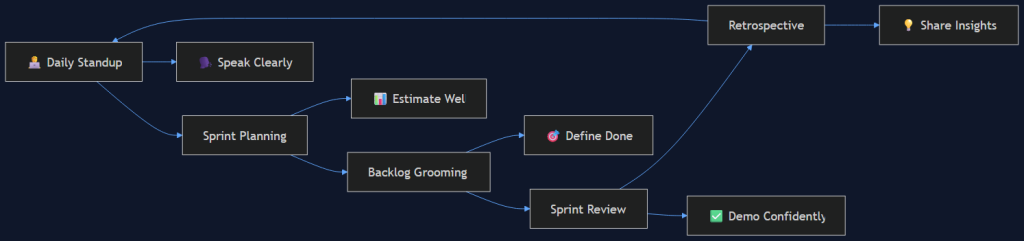
If you work on a software team, Agile rituals are a daily reality — standups, sprint planning, backlog grooming, retrospectives, and of course, bug reports. For Vietnamese developers and tech leads working with international teams, these meetings are both an opportunity and a challenge. The technical content you understand perfectly, but saying it clearly in English? That takes practice.
This guide gives you the exact phrases, vocabulary, and mini-scripts you need to speak confidently in every Agile ceremony.
Why Agile English Feels Different
Agile meetings have their own vocabulary and rhythm. Terms like “velocity”, “blocker”, “acceptance criteria”, and “story points” are technical — but the way you use them in speech matters too. You need to be:
- Concise: Standups are 15 minutes. Nobody wants a 3-minute monologue.
- Clear: Vague updates like “I’m working on it” don’t help the team.
- Confident: Raising a blocker or disagreeing with an estimate requires assertive language.
The good news: Agile English is formulaic. Once you learn the patterns, you can apply them in any standup, any sprint, any team.
🗣️ Key Phrases to Say Out Loud
Practice these until they feel natural. Say each one 3 times before reading on.
“Yesterday I worked on… Today I’m going to…” /ˈjɛstədeɪ aɪ ˈwɜːkt ɒn… təˈdeɪ aɪm ˈɡoʊɪŋ tuː…/
“I’m currently blocked by…” /aɪm ˈkʌrəntli blɒkt baɪ…/
“I’d like to flag a risk on this ticket.” /aɪd laɪk tə flæɡ ə rɪsk ɒn ðɪs ˈtɪkɪt/
“Can we take this offline? It might need a deeper discussion.” /kæn wiː teɪk ðɪs ˈɒflaɪn? ɪt maɪt niːd ə ˈdiːpər dɪˈskʌʃən/
“My estimate for this is around X story points because…” /maɪ ˈɛstɪmət fər ðɪs ɪz əˈraʊnd… ˈstɔːri pɔɪnts bɪˈkɒz…/
“The bug is reproducible on… but not on…” /ðə bʌɡ ɪz rɪˈpruːdəsɪbəl ɒn… bʌt nɒt ɒn…/
“I think we need to revisit the acceptance criteria for this story.” /aɪ θɪŋk wiː niːd tə ˌriːˈvɪzɪt ðə əkˈsɛptəns kraɪˈtɪəriə fər ðɪs ˈstɔːri/
📚 Vocabulary
| Word | Pronunciation | Meaning | Example |
|---|---|---|---|
| Blocker | /ˈblɒkər/ | Something preventing progress | “My blocker is waiting for API access from the backend team.” |
| Velocity | /vəˈlɒsɪti/ | Team’s output per sprint | “Our velocity dropped this sprint because of production incidents.” |
| Retrospective | /ˌrɛtrəˈspɛktɪv/ | Meeting to reflect on what went well/badly | “In the retro, we agreed to improve our code review process.” |
| Acceptance Criteria | /əkˈsɛptəns kraɪˈtɪəriə/ | Definition of when a task is “done” | “The acceptance criteria says the page must load under 2 seconds.” |
| Spike | /spaɪk/ | Research task to reduce uncertainty | “We need a spike to evaluate which caching library to use.” |
| Grooming | /ˈɡruːmɪŋ/ | Refining and estimating backlog items | “During grooming, we broke the user story into 3 smaller tasks.” |
| Throughput | /ˈθruːpʊt/ | Number of items completed | “Our throughput this quarter averaged 12 tickets per sprint.” |
🎯 Practice Now
Standup Script — Fill in the blanks
Use this script for your next standup. Speak it out loud, clearly and at a natural pace.
“Yesterday, I [completed / worked on / reviewed] _______. Today, I’m planning to [start / finish / investigate] _______. I [don’t have any blockers / am blocked by _______]. I [expect to hit / might miss] the sprint goal for this ticket because _______.”
Example (say this out loud):
“Yesterday, I finished the login API integration and fixed two failing unit tests. Today, I’m going to write the integration tests and update the Swagger docs. I’m currently blocked by the QA environment — it’s been down since this morning. I’ve pinged DevOps, but if it’s not resolved by noon, it might push my ticket to next sprint.”
Bug Report Dialogue
Imagine you’re in a ticket review with your Scrum Master. Practice both roles.
You (Developer):
“I want to flag a regression we found in the payment flow. The bug is reproducible on Chrome 123 and Safari 17, but not on Firefox. The root cause appears to be a race condition in the checkout state manager. I’d estimate it’s a P1 — it’s blocking users from completing purchases.”
Scrum Master:
“Thanks for flagging that. Do you have a fix in mind?”
You:
“Yes, I have a fix ready. I’d like to request an emergency review today so we can hotfix before the end of business.”
Read this dialogue 3 times. Try to do it faster each time without losing clarity.
Retrospective — Speaking Your Mind
Retros are where your opinion matters. These phrases help you contribute:
- What went well: “I think our deployment pipeline worked really smoothly this sprint. Zero rollbacks — that’s a win.”
- What could improve: “I noticed we spent a lot of time in review because some PRs were too large. Could we agree on a 200-line limit?”
- Action item: “I’d like to own the task of documenting our branching strategy so new joiners can onboard faster.”
Practice each one. Notice how each sentence states a fact, then offers a conclusion or action. This is the pattern native English speakers use in meetings.
⏱️ 5-Minute Drill
Set a timer for 5 minutes. Read this entire script out loud — slowly and clearly. Focus on the bold words.
“Good morning, team. Let me give you my standup update.
Yesterday, I completed the backend changes for the notification service and submitted a PR for review. The PR is linked in the ticket — it’s a relatively small change, about 120 lines.
Today, I’m going to address the review comments and then start the frontend integration. I’m estimating around 3 hours for that.
I do have one blocker: I need the design team to confirm the final icon set before I can finalize the UI. I’ve sent them a message but haven’t heard back yet. If anyone has a direct line to Linh or Nam on the design team, that would be super helpful.
One risk I want to flag: the sprint ends Thursday, and if the design feedback comes late, I might need to descope the icon update to next sprint. I’ll keep the team informed.
That’s it from me. Thanks.”
When you’re done, replay the drill — this time faster. Can you finish it in 3 minutes while still sounding natural?
Real Talk: Common Vietnamese Speaker Mistakes in Agile Meetings
Too vague: “I’m working on it” → Say: “I’m 70% done with the search filter feature. Should be ready by 3 PM today.”
No context for blockers: “I’m blocked” → Say: “I’m blocked waiting for the staging credentials. I’ve emailed IT — ticket ID is INC-4421.”
Silent disagreement: In Agile teams, silence is agreement. If you disagree, say: “I’d push back on that estimate slightly. Here’s my thinking…”
Skipping the ‘why’: “I estimate 8 points” tells the team nothing. Add: “…because there are three edge cases in the payment flow that need separate handling.”
Summary
Agile meetings are highly structured — and that structure is your friend. Learn the 5 standup sentences, the 3 retrospective patterns, and the bug report formula. Practice them until they’re automatic.
The goal isn’t perfect English. It’s clear, confident communication that moves the team forward.
Tomorrow, in your standup, try using at least one new phrase from this guide. See what happens.
Related reading

15 Jul 2026 · 7 min read
ai-tools
Tech Lead English: AI-Assisted Code Reviews — What to Say and How to Say It
Practical English phrases, vocabulary, and scripts for Vietnamese tech leads discussing AI-generated code suggestions in code reviews. How to evaluate AI output and communicate your decisions to the team.
Read more
15 Jul 2026 · 6 min read
AI-vocabulary
English Lesson — Tuesday Evening: Review AI Vocabulary + Listening Tips
Daily English practice for tech professionals. Tuesday evening — review AI vocabulary from morning and noon sessions, plus listening comprehension strategies for technical English content.
Read more
28 Jun 2026 · 4 min read
demo
Speaking Skills: How to Present and Demo Your Work in English
English speaking skills for Vietnamese developers presenting work to international stakeholders — demo scripts, storytelling frameworks, and pronunciation drills for impactful presentations.
Read more
Discussion
Comments are reviewed before publication. Your email is kept private.