
JOURNAL
Agile English: Daily Standup & Blocker Communication
English phrases for daily standups, reporting progress, raising blockers, and communicating status in Scrum/Agile teams. For Vietnamese developers working in international or cross-functional environments.
On this page
Agile English: Daily Standup & Blocker Communication
Context: The daily standup is the most frequent high-stakes English moment for developers on international teams. 15 minutes. Everyone listening. You need to be clear, concise, and confident — in 3 sentences.
This session covers the exact phrases that make standups smooth, plus how to raise blockers without sounding helpless or vague.
🗣️ Key Phrases to Say Out Loud
Say each 3 times with natural rhythm:
| Phrase | IPA | Use case |
|---|---|---|
| “Yesterday I completed…” | /ˈjestədeɪ aɪ kəmˈpliːtɪd/ | Report done work |
| “Today I’m planning to…” | /təˈdeɪ aɪm ˈplænɪŋ tuː/ | State today’s goal |
| “I’m blocked by…” | /aɪm blɒkt baɪ/ | Raise a blocker |
| “I need input from…” | /aɪ niːd ˈɪnpʊt frɒm/ | Ask for help |
| “I’ll take this offline with…” | /aɪl teɪk ðɪs ˈɒflaɪn wɪð/ | Move detail out |
| “No blockers on my end.” | /nəʊ ˈblɒkəz ɒn maɪ end/ | Clean update |
| “I’m at risk of missing…” | /aɪm æt rɪsk ɒv ˈmɪsɪŋ/ | Flag early warning |
📚 Vocabulary: Standup & Agile Status Language
| Word | IPA | Vietnamese | Example |
|---|---|---|---|
| blocker | /ˈblɒkər/ | vật cản, điều ngăn cản | “The blocker is waiting on the API spec from the backend team.” |
| dependency | /dɪˈpendənsi/ | sự phụ thuộc | “I have a dependency on the design team’s review.” |
| at risk | /æt rɪsk/ | có nguy cơ | “The Friday deadline is at risk — we found a regression.” |
| in progress | /ɪn ˈprəʊɡres/ | đang thực hiện | “The migration script is in progress — 60% done.” |
| carry over | /ˈkæri ˈoʊvər/ | chuyển sang ngày/sprint tiếp theo | “I’ll carry this ticket over to tomorrow — more complex than estimated.” |
| regression | /rɪˈɡreʃən/ | lỗi quay lại sau khi đã sửa | “Deployment caused a regression in the payment flow.” |
| ETA | /iː tiː eɪ/ | estimated time of arrival — thời gian hoàn thành dự kiến | “What’s your ETA on the code review?” |
🎯 Practice Now: 3-Sentence Standup Formula
The formula:
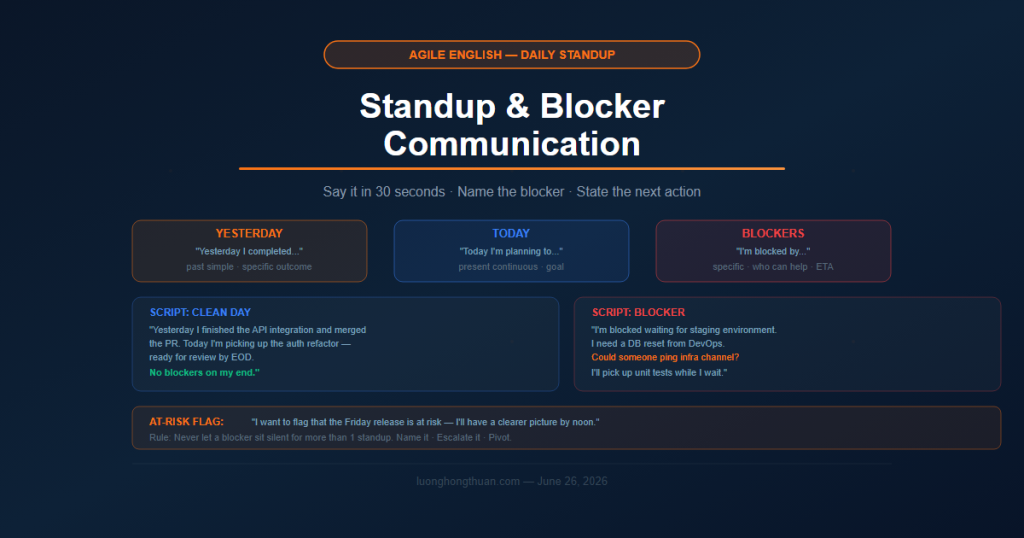
- Yesterday: What you completed (use past simple)
- Today: What you’re working on (use present continuous or plan to + verb)
- Blockers: What’s blocking you — or “no blockers”
Script 1: Clean day, no blockers
“Yesterday I finished the API integration for the user profile endpoint and merged the PR. Today I’m picking up the authentication refactor — should be ready for review by end of day. No blockers on my end.”
Say this aloud. Then replace with your real yesterday/today/blockers.
Script 2: Real blocker, needs help
“Yesterday I made progress on the database migration — schema changes are done. Today I’m blocked waiting for the staging environment to be unblocked — I need a DB password reset from DevOps. Could someone ping the infra channel? Otherwise I’ll pick up the unit tests while I wait.”
Key moves:
- Named the blocker specifically (not “I’m blocked” — “blocked by X”)
- Asked for action from someone specific (DevOps)
- Already pivoting to alternative work (not just stopping)
Script 3: At-risk flag
“Yesterday I was investigating a performance issue in the search endpoint — turns out it’s a missing index. Today I’m implementing the fix and running load tests. I want to flag that the Friday release is at risk — the fix needs a migration and I want to make sure we test it properly. I’ll have a clearer picture by noon.”
Key moves:
- “I want to flag” — signals importance without alarm
- Named the specific risk (migration + testing)
- Gave a timeline for more info (by noon)
⏱️ 5-Minute Drill
Set a timer. Don’t stop until it rings.
Minute 1: Say the 7 Key Phrases (table above) out loud. Focus on rhythm, not just words.
Minute 2: Say Script 1 from memory. Replace with your actual work — make it real.
Minute 3: Think of ONE real blocker you have (or had this week). Say Script 2 format with that blocker. Out loud.
Minute 4: Say this sentence 5 times fast:
“I’m at risk of missing the milestone — I need input from the platform team.”
Minute 5: Record yourself saying your standup update for tomorrow. Listen back. Note where you hesitated. That’s what to practice tonight.
🚫 Common Mistakes in Standups
| ❌ What Vietnamese devs say | ✅ More professional version |
|---|---|
| “I do the task about login yesterday.” | “Yesterday I worked on the login feature.” |
| “I have problem with API.” | “I’m blocked by an API issue — the endpoint returns a 401 intermittently.” |
| “Today I will try to finish…” | “Today I’m planning to complete X and have it ready for review.” |
| “I cannot finish because…” | “I’m carrying this over — it’s more complex than estimated. New ETA: tomorrow noon.” |
| “Maybe finish Friday?” | “I expect to complete this by Friday EOD — let me know if that timeline needs to move.” |
Common pattern: Be specific about WHAT, add an ETA, state next action. Remove “maybe”, “try”, “cannot”.
🗓️ Blocker Escalation Framework
When your blocker isn’t resolved after 1 standup, escalate clearly:
Day 1 (in standup):
“I’m blocked on [X] — I need [Y] from [person/team].”
Day 2 (if still blocked):
“Still blocked on [X]. I pinged [person] yesterday — following up now. [Person], can we sync after this standup?”
Day 3 (to manager):
“This blocker is now 3 days old and it’s impacting the sprint goal. Can you help unblock this?”
The rule: Never let a blocker sit silent. Surface it, name it, give it a timeline.
💬 Bonus: Async Standup (Slack/Written)
If your team does async standups in Slack:
Template:
🗓️ Standup — June 26

✅ Yesterday: [what you completed]
🔨 Today: [what you're working on]
🚧 Blockers: [specific blocker or "None"]
⚠️ At risk: [anything that might slip — or "Nothing flagged"]
This format works better than free text — it’s scannable and surfaces risks immediately.
🌟 This Week’s Pattern
You’ve practiced a complete set of Agile English this week:
- Sprint planning (Monday)
- Bug reports (Tuesday)
- Estimation (Wednesday)
- Retrospectives (Thursday)
- Daily standups + blocker communication (Friday)
Next week: we’ll start a new rotation with more advanced scenarios — cross-team dependencies, incident communication, and architecture decision discussions.
A great standup is 30 seconds. A poor one wastes 15 minutes. Practice the phrases until they’re automatic — so your brain can focus on the content, not the language.
Related reading
03 Sep 2026 · 4 min read
communication
English Lesson — Thursday Morning: Elaborating & Explaining Clearly
Daily English practice for tech professionals. Morning session covering the language of explaining ideas in more depth — elaborate, walk through, break it down — with pronunciation guide, exercises, and real-world examples.
Read more
15 Jul 2026 · 7 min read
ai-tools
Tech Lead English: AI-Assisted Code Reviews — What to Say and How to Say It
Practical English phrases, vocabulary, and scripts for Vietnamese tech leads discussing AI-generated code suggestions in code reviews. How to evaluate AI output and communicate your decisions to the team.
Read more
28 Jun 2026 · 4 min read
demo
Speaking Skills: How to Present and Demo Your Work in English
English speaking skills for Vietnamese developers presenting work to international stakeholders — demo scripts, storytelling frameworks, and pronunciation drills for impactful presentations.
Read more
Discussion
Comments are reviewed before publication. Your email is kept private.