
JOURNAL
Agile & QC English: Sprint Meetings, Bug Reports, and Estimates
Master English for Agile sprints: report bugs clearly, discuss estimates, handle scope changes. Practical phrases for Vietnamese developers in international teams.
On this page
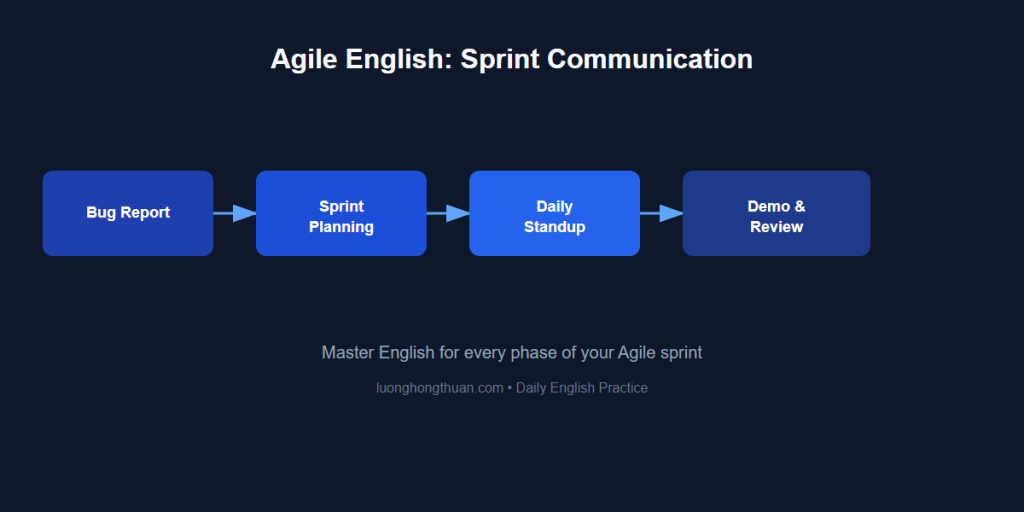
Working in an Agile team with international colleagues? Whether you’re joining a sprint planning call, writing a bug report, or giving estimates in a daily standup, the right English phrases make you sound confident and professional. This lesson covers the language you need for every phase of an Agile sprint.
🗣️ Key Phrases to Say Out Loud
Practice these until they feel natural. Say each one three times before your next meeting.
| Phrase | IPA | When to use |
|---|---|---|
| rough estimate | /rʌf ˈestɪmɪt/ | When you haven’t analysed fully but need to give a number |
| ballpark figure | /ˈbɔːlpɑːrk ˈfɪɡər/ | Informal synonym for rough estimate, common in standups |
| spike needed | /spaɪk ˈniːdɪd/ | When research/investigation is required before estimation |
| acceptance criteria | /əkˈseptəns kraɪˈtɪriə/ | The conditions a story must meet to be “done” |
| blocking issue | /ˈblɒkɪŋ ˈɪʃuː/ | Something stopping you from progressing |
| edge case | /edʒ keɪs/ | An unusual or extreme scenario that may break the feature |
Tip: Record yourself saying each phrase. Vietnamese speakers often soften the hard /k/ in “spike” and “blocking” — make it crisp and clear.
📚 Vocabulary
1. Scope creep /skəʊp kriːp/ Noun. When a project’s requirements expand beyond the original plan. Example: “We need to avoid scope creep — let’s add that feature to the backlog instead.”
2. Velocity /vəˈlɒsɪti/ Noun. The amount of work a team completes in a sprint, measured in story points. Example: “Our velocity last sprint was 32 points, so let’s plan for that this time.”
3. Reproduce /ˌriːprəˈdjuːs/ Verb. To make a bug happen again in order to investigate it. Example: “I can reproduce this bug on Chrome but not on Safari.”
4. Regression /rɪˈɡreʃən/ Noun. A previously working feature that breaks after a new change. Example: “This looks like a regression — the login worked fine before the last deploy.”
5. Triage /ˈtriːɑːʒ/ Verb/Noun. To assess and prioritise issues by severity. Example: “Let’s triage these bugs before the sprint review so we know what’s critical.”
6. Sign off /saɪn ɒf/ Phrasal verb. To formally approve that work meets requirements. Example: “Can the product owner sign off on this story by end of day?”
🎯 Practice Now
Sprint Planning Dialogue
Setting: A Vietnamese developer (Dev) and a Scrum Master (SM) in a sprint planning call.
SM: Okay, let’s look at the next story — user profile photo upload. Can you give us a rough estimate?
Dev: I need a bit more information. What are the acceptance criteria exactly?
SM: The user should be able to upload a JPG or PNG, max 5 MB, and see the preview before saving.
Dev: Got it. I’d say around five to eight story points. There might be some edge cases with file validation that could take extra time.
SM: Is there anything blocking you on this one?
Dev: Not yet, but I think we’ll need a spike for the image compression logic. I’m not sure which library to use — that could take half a day of investigation.
SM: Fair enough. Let’s add a one-point spike first, then we can re-estimate the main story next sprint.
Dev: That works for me. One more thing — I noticed a regression in the current upload feature. Should I log that as a separate bug?
SM: Yes please, log it with steps to reproduce and we’ll triage it after this meeting.
Dev: Will do. I’ll have it in Jira before the end of standup.
SM: Perfect. Let’s move on to the next story.
Bug Report Template
Use this structure every time you write a bug report in English:
Title: [Component] Short description of the problem

Environment:
- Browser / Device: Chrome 124 / MacOS
- App version: v2.3.1
- Test environment: Staging

Steps to Reproduce:
1. Navigate to [page/feature]
2. [Do action]
3. [Do action]
4. Observe the result

Expected Result:
[What should happen]

Actual Result:
[What actually happens]

Severity: Critical / High / Medium / Low

Additional Notes:
- This appears to be a regression introduced in PR #[number]
- I can reproduce this consistently (100% reproduction rate)
- Workaround: [if any]

Attachments: [screenshots / video / logs]
Example title: [Profile] Photo upload fails silently on files over 3 MB
Common Estimation Phrases
Use these in planning meetings and standups:
- “I estimate X story points for this task.”
- “Based on our velocity, we can take about 30 points this sprint.”
- “This is just a ballpark figure — I’ll have a better estimate after I look at the code.”
- “We need a spike for this. I can investigate it in half a day and report back.”
- “This could be 3 to 5 days, depending on how complex the API integration is.”
- “I’m not confident in my estimate — there are too many unknowns. Can we break this story down?”
- “If we include the edge cases, I’d add two more points to be safe.”
- “That’s out of scope for this sprint. Let’s move it to the backlog and revisit it.”
Quick Confidence Check
Before your next sprint meeting, ask yourself:
- Can you explain a blocking issue in one sentence?
- Can you give a rough estimate and say why you’re uncertain?
- Can you write a bug report with clear steps to reproduce?
If yes — you’re ready. If not — reread this lesson and run through the dialogue one more time out loud. The goal is fluency under pressure, not just knowing the words on paper.
Related reading

15 Jul 2026 · 7 min read
ai-tools
Tech Lead English: AI-Assisted Code Reviews — What to Say and How to Say It
Practical English phrases, vocabulary, and scripts for Vietnamese tech leads discussing AI-generated code suggestions in code reviews. How to evaluate AI output and communicate your decisions to the team.
Read more
15 Jul 2026 · 6 min read
AI-vocabulary
English Lesson — Tuesday Evening: Review AI Vocabulary + Listening Tips
Daily English practice for tech professionals. Tuesday evening — review AI vocabulary from morning and noon sessions, plus listening comprehension strategies for technical English content.
Read more
28 Jun 2026 · 4 min read
demo
Speaking Skills: How to Present and Demo Your Work in English
English speaking skills for Vietnamese developers presenting work to international stakeholders — demo scripts, storytelling frameworks, and pronunciation drills for impactful presentations.
Read more
Discussion
Comments are reviewed before publication. Your email is kept private.