
JOURNAL
Agile English: Running Sprint Retrospectives That Actually Work
How to facilitate sprint retrospectives in English — phrases, vocabulary, and scripts for Vietnamese tech leads managing international teams.
On this page
The sprint retrospective is the most important ceremony in Scrum — and the one most often done poorly. A bad retro is a 30-minute venting session. A good retro produces concrete improvements that make the next sprint noticeably better.
In English, running a good retro requires specific facilitation language: phrases that draw out honest feedback, build psychological safety, and move the team toward actionable commitments.
🗣️ Key Phrases to Say Out Loud
Opening the retro:
“Let’s take a moment to reflect on the sprint before we look ahead.” /lɛts teɪk ə ˈməʊmənt tə rɪˈflɛkt ɒn ðə sprɪnt bɪˈfɔːr wiː lʊk əˈhɛd/ — Signals reflection, not blame. Sets the tone.
“This is a safe space — what’s said in the retro stays in the retro.” /ðɪs ɪz ə seɪf speɪs — wɒts sɛd ɪn ðə ˈretrəʊ steɪz ɪn ðə ˈretrəʊ/ — Builds psychological safety before people speak honestly.
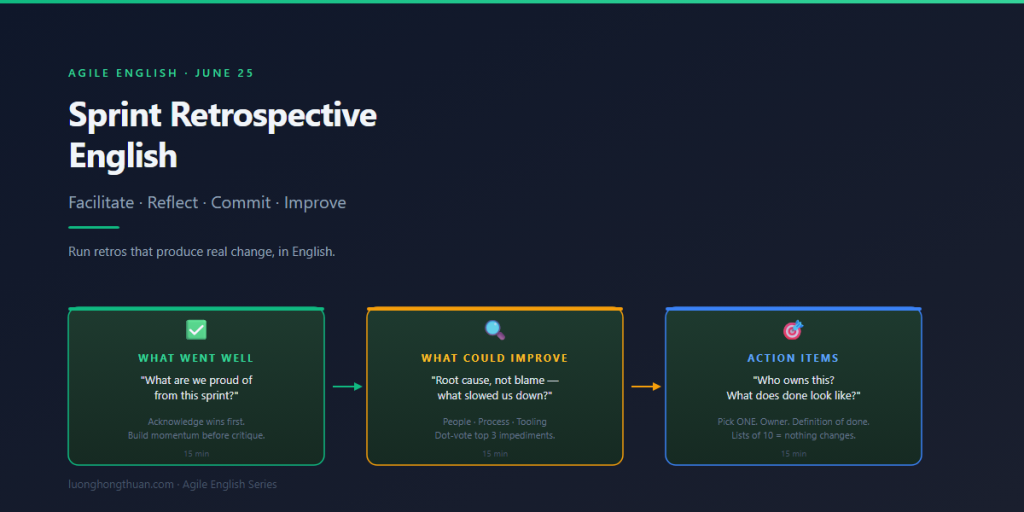
What went well: 3. “What are we proud of from this sprint? Let’s acknowledge the wins.” /wɒt ɑːr wiː praʊd ɒv frɒm ðɪs sprɪnt — lɛts ækˈnɒlɪdʒ ðə wɪnz/ — Specific and positive. “Proud of” invites ownership, not just reporting.
What could improve: 4. “What slowed us down this sprint? I want to understand the root cause, not assign blame.” /wɒt sləʊd ʌs daʊn ðɪs sprɪnt — aɪ wɒnt tə ˌʌndəˈstænd ðə ruːt kɔːz nɒt əˈsaɪn bleɪm/ — Critical phrase. “Root cause, not blame” makes people feel safe to name real problems.
- “Is this a people problem, a process problem, or a tooling problem?” /ɪz ðɪs ə ˈpiːpl ˈprɒbləm ə ˈprəʊsɛs ˈprɒbləm ɔːr ə ˈtuːlɪŋ ˈprɒbləm/ — Diagnostic framing. Stops people from defaulting to “we need to work harder.”
Action items: 6. “Let’s commit to one thing we will do differently next sprint — not a list, just one.” /lɛts kəˈmɪt tə wʌn θɪŋ wiː wɪl duː ˈdɪfrəntli nɛkst sprɪnt — nɒt ə lɪst dʒʌst wʌn/ — Discipline. One actionable commitment beats five vague ones every time.
- “Who owns this action item, and what does done look like?” /huː əʊnz ðɪs ˈækʃən ˈaɪtəm ænd wɒt dʌz dʌn lʊk laɪk/ — Turns a suggestion into an accountable commitment with a clear definition of done.
📚 Vocabulary
| Word | IPA | Vietnamese | Example |
|---|---|---|---|
| impediment | /ɪmˈpedɪmənt/ | trở ngại, vật cản | “The main impediment this sprint was unclear requirements.” |
| actionable | /ˈækʃənəbl/ | có thể thực hiện được | “The feedback needs to be actionable, not just a feeling.” |
| facilitation | /fəˌsɪlɪˈteɪʃən/ | việc điều phối, dẫn dắt | “Good facilitation means everyone speaks, not just the loud ones.” |
| root cause | /ruːt kɔːz/ | nguyên nhân gốc rễ | “We fixed the symptom, not the root cause.” |
| velocity | /vɪˈlɒsɪti/ | tốc độ sprint (story points/sprint) | “Our velocity dropped — was it complexity or scope creep?” |
| psychological safety | /ˌsaɪkəˈlɒdʒɪkəl ˈseɪfti/ | môi trường an toàn để nói thật | “Without psychological safety, retros surface only safe complaints.” |
🎯 Practice Now
Scenario: Your Sprint Retrospective as Facilitator
It is the end of the sprint. Two bugs slipped into production. The deployment took 3 hours instead of 1. One team member feels their PR feedback was too harsh. You are running the retro.
Opening (say aloud):
“Thanks everyone for making time. This sprint had some challenges — let’s use the next 45 minutes to understand what happened and decide what to change. Ground rule: we focus on systems and processes, not individuals. Everything said here stays between us.”
What went well (say aloud):
“Let’s start with wins. What are we proud of? Even in a tough sprint, something went right.” (Wait. If silence, prompt:) “What about the backend refactor that shipped on Tuesday?”
What could improve (say aloud):
“Now, what slowed us down? I heard some things about the deployment process. Who wants to start?” (After someone speaks:) “Thank you for naming that. Is this a process issue — like missing a checklist — or is it a communication issue between teams?”
Action item (say aloud):
“We have three ideas. Let’s pick the one with the highest impact. I nominate: adding a deployment checklist with a required sign-off before prod release. Who wants to own this? What does done look like — draft by Monday?”
Mini-exercise: Reframe the Complaint
In retros, team members often express frustration as complaints. Practice reframing each one into a constructive observation:
| Complaint | Reframe |
|---|---|
| “The requirements keep changing!” | “We need a clearer process for mid-sprint scope changes.” |
| “Nobody reviews my PRs fast enough.” | “PR review SLA is undefined — what’s our target turnaround?” |
| “The staging environment is always broken.” | “We need an owner for staging environment health — who can take this?” |
| “Meetings take too long.” | “Let’s timeblock this retro and try 30 minutes next sprint.” |
Practice: Say each reframe aloud. Notice how the reframe names a system problem, not a person problem. That is the skill.
The One-Change Rule
Most retros produce a list of 5-10 improvements. Most are never implemented. The antidote:
Pick ONE thing. Make it specific. Assign ONE owner. Define done.
“By next sprint planning, Minh will draft a deployment checklist and share it in Slack for team review. Done = the team has seen and approved it before Thursday’s standup.”
That is an action item. “We should improve our deployment process” is not.
Facilitation Tip: The 5-5-5 Format
For a 45-minute retro:
- 15 min — What went well (everyone adds sticky notes / writes in Miro)
- 15 min — What could improve (same, then dot-vote on top 3)
- 15 min — Action items (one per top impediment, with owner and definition of done)
Say this to open: “We have 45 minutes. I want us to leave with one concrete commitment we can track. Let’s make it count.”
Real-world tip: Run the Retro in Writing First
Before the meeting, send a Slack message:
“Sprint retro tomorrow at 2 PM. Please add your thoughts here before then: What went well? What was hard? What should we try next sprint?”
This gives introverts time to prepare, and means the meeting itself focuses on discussion — not data gathering. Say in the meeting: “I’ve reviewed everyone’s notes — let me highlight the themes I’m seeing…”
Next: Friday Morning — Career & Growth: Asking for a Promotion or Salary Review
Related reading

15 Jul 2026 · 7 min read
ai-tools
Tech Lead English: AI-Assisted Code Reviews — What to Say and How to Say It
Practical English phrases, vocabulary, and scripts for Vietnamese tech leads discussing AI-generated code suggestions in code reviews. How to evaluate AI output and communicate your decisions to the team.
Read more
15 Jul 2026 · 6 min read
AI-vocabulary
English Lesson — Tuesday Evening: Review AI Vocabulary + Listening Tips
Daily English practice for tech professionals. Tuesday evening — review AI vocabulary from morning and noon sessions, plus listening comprehension strategies for technical English content.
Read more
28 Jun 2026 · 4 min read
english
Speaking Practice: Numbers, Metrics & Technical Data in English
Pronunciation drills and shadowing exercises for Vietnamese developers presenting technical metrics — load times, percentages, error rates, and large numbers in English meetings.
Read more
Discussion
Comments are reviewed before publication. Your email is kept private.