
JOURNAL
QC & Agile English: Sprint Estimation — Story Points, T-Shirt Sizing, and Confidence
Master the English phrases for sprint estimation meetings — how to give story point estimates, flag risks, push back on unrealistic timelines, and explain trade-offs in international Agile teams.
On this page
Sprint Estimation English: Say What You Mean, Commit to What You Can Deliver
Estimation meetings are where trust is built or broken. Over-commit and miss the sprint. Under-estimate and appear low-impact. Refuse to give a number and seem unhelpful. And all of this happens in English — where one awkward phrase can undermine an otherwise solid estimate.
This post gives you the exact vocabulary and phrases to participate confidently in sprint estimation meetings.
The Core Challenge for Vietnamese Engineers
In Vietnamese work culture, giving a low estimate signals modesty and leaves room for error. In international Agile teams, a too-low estimate followed by missing the deadline damages your credibility more than giving a higher estimate upfront.
You need to communicate:
- Your estimate (with a number and unit)
- Your confidence level
- Any risks or unknowns that affect the estimate
- When you’d push back or ask to split a story
🗣️ Key Phrases to Say Out Loud
Practice these 5 times each:
| Phrase | IPA | When to Use |
|---|---|---|
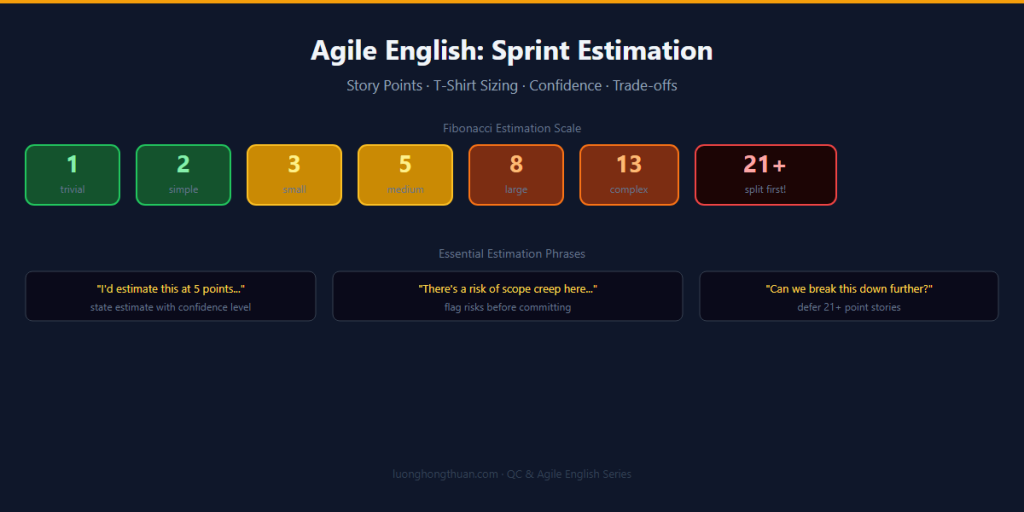
| “I’d estimate this at five points.” | /aɪd ˈɛstɪmeɪt ðɪs æt faɪv pɔɪnts/ | Giving a story point estimate |
| “There’s a risk of scope creep here.” | /ðɛrz ə rɪsk əv skəʊp kriːp hɪər/ | Flagging that a story could expand |
| “I’m not confident in this estimate.” | /aɪm nɒt ˈkɒnfɪdənt ɪn ðɪs ˈɛstɪmət/ | Signaling high uncertainty |
| “Can we break this down further?” | /kæn wiː breɪk ðɪs daʊn ˈfɜːðər/ | Requesting a story split |
| “My estimate assumes X is already done.” | /maɪ ˈɛstɪmət əˈsjuːmz X ɪz ɔːlˈrɛdi dʌn/ | Stating dependencies clearly |
| “I’d call this a medium — maybe an 8.” | /aɪd kɔːl ðɪs ə ˈmiːdiəm ˈmeɪbi ən eɪt/ | T-shirt to point conversion |
| “This has a lot of unknowns — let’s spike it.” | /ðɪs hæz ə lɒt əv ʌnˈnəʊnz lɛts spaɪk ɪt/ | Proposing a spike story |
📚 Vocabulary: Estimation Terms
| Term | Pronunciation | Vietnamese | Example |
|---|---|---|---|
| story points | /ˈstɔːri pɔɪnts/ | điểm câu chuyện — đơn vị đo effort tương đối | “I’d give this 8 story points.” |
| velocity | /vɪˈlɒsɪti/ | vận tốc — số story points team hoàn thành mỗi sprint | “Our velocity is 40 points per sprint.” |
| scope creep | /skəʊp kriːp/ | mở rộng phạm vi không kiểm soát | “This feature has scope creep risk — the requirements keep changing.” |
| spike | /spaɪk/ | time-boxed research task — nghiên cứu kỹ thuật trước khi estimate | “Let’s spike this for 2 days before committing to a point estimate.” |
| acceptance criteria | /əkˈsɛptəns kraɪˈtɪəriə/ | tiêu chí chấp nhận — điều kiện để coi story là done | “The acceptance criteria aren’t clear — I can’t estimate without them.” |
| t-shirt sizing | /tiː ʃɜːt ˈsaɪzɪŋ/ | ước tính bằng cỡ áo (XS/S/M/L/XL) trước khi dùng điểm | “Quick t-shirt sizing first: I’d call this a Large.” |
| buffer | /ˈbʌfər/ | thời gian dự phòng | “My estimate includes a buffer for integration testing.” |
How to Give an Estimate (4-Part Formula)
Use this structure every time you give an estimate:
1. State the number: “I’d estimate this at [X] points / [size] / [time].”
2. State your confidence:
- High: “I’m fairly confident in that.”
- Medium: “That could go up to [Y] if [condition].”
- Low: “I’m not confident — there are too many unknowns.”
3. State dependencies/assumptions:
- “This assumes the API contract is finalized.”
- “My estimate assumes we’re not doing X.”
4. Flag risks:
- “There’s a scope creep risk here — the requirements aren’t fully defined.”
- “We might need a spike before we can estimate properly.”
🎯 Practice Now
Dialogue 1: Standard Estimate
Scrum Master: “Okay, the next story is ‘Add OAuth login with Google.’ Who wants to start?”
You: “I’d estimate this at 8 points. We have OAuth experience from the GitHub integration last sprint, so the complexity is familiar — but I’m assuming the Google Cloud credentials are already set up. If we need to create the project from scratch, it could go to 13.”
Scrum Master: “Fair. Anyone else?”
Teammate: “I was thinking 5 — we have a library for this.”
You: “Good point. If we’re using [library name], maybe 5 is right. I hadn’t factored that in.”
Dialogue 2: Pushing Back on an Under-estimate
PM: “Can we estimate this as a 3? It’s just a UI change.”
You: “I’d push back on 3 — the UI touches the state management layer, and we’ll need to update the test suite. I’d call this at least a 5, maybe 8 if the state changes are complex. Can we look at the acceptance criteria more closely?”
Exercise: Estimate Out Loud
Look at this story title: “Migrate user authentication from JWT to session-based auth.”
Say your estimate out loud using the 4-part formula:
- How many story points?
- Your confidence level?
- Any assumptions?
- Any risks?
There’s no correct answer — the practice is saying it fluently and confidently in English.
Common Phrases to Avoid (and What to Say Instead)
| ❌ Avoid | ✅ Say Instead |
|---|---|
| “I don’t know.” | “There are too many unknowns — I’d recommend a spike first.” |
| “It’s very complicated.” | “There’s significant complexity here — I’d estimate 13 points.” |
| “Maybe 3 or maybe 8.” | “My estimate is 5, but it could range from 3 to 8 depending on X.” |
| “I think it’s easy.” | “This looks like a 2 — we’ve done similar work before.” |
| “It will take a long time.” | “This is a 13-pointer — we might want to split it before committing.” |
Today’s Quick Win
In your next standup or estimation meeting, use the phrase:
“My estimate assumes [one dependency or assumption].”
Adding your assumptions to estimates makes you look senior — it shows you’ve thought through the problem, not just guessed a number.
Tomorrow: QC & Agile English — How to Write and Deliver a Sprint Demo Update 🎬
Related reading
03 Sep 2026 · 4 min read
communication
English Lesson — Thursday Morning: Elaborating & Explaining Clearly
Daily English practice for tech professionals. Morning session covering the language of explaining ideas in more depth — elaborate, walk through, break it down — with pronunciation guide, exercises, and real-world examples.
Read more
15 Jul 2026 · 7 min read
ai-tools
Tech Lead English: AI-Assisted Code Reviews — What to Say and How to Say It
Practical English phrases, vocabulary, and scripts for Vietnamese tech leads discussing AI-generated code suggestions in code reviews. How to evaluate AI output and communicate your decisions to the team.
Read more
28 Jun 2026 · 4 min read
demo
Speaking Skills: How to Present and Demo Your Work in English
English speaking skills for Vietnamese developers presenting work to international stakeholders — demo scripts, storytelling frameworks, and pronunciation drills for impactful presentations.
Read more
Discussion
Comments are reviewed before publication. Your email is kept private.