
JOURNAL
QC English: How to Write Clear Bug Reports
Master the English phrases and structure for writing professional bug reports — the QC vocabulary every Vietnamese developer needs for international teams.
On this page
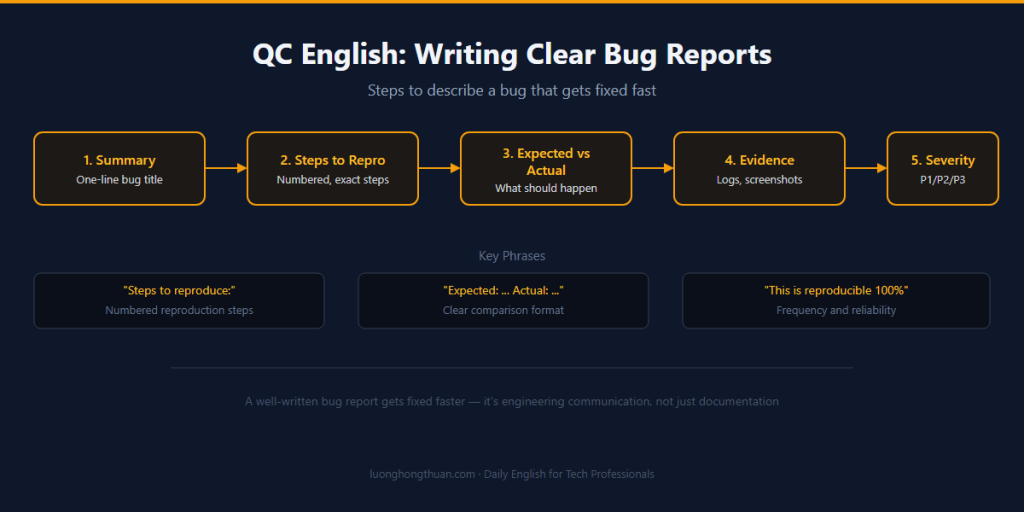
QC English: Writing Bug Reports That Get Fixed Fast
A bug report written in clear English is a force multiplier for your whole team. When devs, PMs, and stakeholders all understand the issue immediately, the bug gets triaged faster, fixed faster, and closed faster.
This guide gives you the exact vocabulary and format used by QC engineers in international tech companies.
🗣️ Key Phrases to Say Out Loud
| Phrase | IPA | When to Use |
|---|---|---|
| “Steps to reproduce” | /stɛps tə rɪˈpruːs/ | Standard bug report header |
| “This is reproducible consistently” | /rɪˌpruːdʒuːˈsɪbəl/ | Confirming the bug always happens |
| “Expected behavior” | /ɪkˈspektɪd bɪˈheɪvjər/ | What the app should do |
| “Actual behavior” | /ˈæktʃuəl bɪˈheɪvjər/ | What the app actually does |
| “Intermittent issue” | /ˌɪntəˈmɪtənt ˈɪʃuː/ | Bug that doesn’t happen every time |
| “Blocking the release” | /ˈblɒkɪŋ ðə rɪˈliːs/ | Critical severity — cannot ship |
| “Attached logs for reference” | — | When you include evidence |
📚 Vocabulary: QC & Bug Report Language
1. Reproduce /ˌriːprəˈdjuːs/ — tái hiện lại bug
“I can reproduce the crash consistently on iOS 17 but not on iOS 16.”
2. Regression /rɪˈɡrɛʃən/ — bug mới xuất hiện sau khi deploy
“This looks like a regression — the feature worked fine in v2.3 but broke in v2.4.”
3. Severity /sɪˈvɛrɪti/ — mức độ nghiêm trọng của bug
“I’m flagging this as P1 severity — it blocks user login on mobile.”
4. Root cause /ruːt kɔːz/ — nguyên nhân gốc rễ
“The root cause was a missing null check in the authentication middleware.”
5. Workaround /ˈwɜːkəraʊnd/ — cách tạm thời tránh bug
“There’s a workaround: clear the cache before logging in. But we need a real fix.”
6. Edge case /ɛdʒ keɪs/ — trường hợp ngoại lệ
“This only happens in an edge case: when the user has zero items in the cart and applies a coupon code.”
🎯 Practice Now: Write a Bug Report
Use this template structure — read it out loud and then fill in your own example:
Bug Title: [Component] — [What broke] — [Where/When]
Example: “Checkout — Payment button disabled after promo code applied — Mobile Safari only”
Steps to Reproduce:
- Open the app on an iOS device using Safari
- Add any item to the cart
- Apply promo code “SAVE20” at checkout
- Observe the payment button
Expected Behavior:
The payment button should remain active and allow the user to complete the purchase.
Actual Behavior:
The payment button becomes disabled (greyed out) immediately after the promo code is applied. Clicking it has no effect.
Severity: P1 — Blocking (prevents purchase on iOS Safari)
Reproducibility: 100% reproducible on iOS 15+, Safari only. Works correctly on Chrome iOS and Android.
Evidence: [Screenshot attached] [Console error: “TypeError: Cannot read property ‘total’ of undefined”]
Environment:
- Device: iPhone 14, iOS 16.3
- Browser: Safari 16
- App version: 3.2.1
Now say this out loud:
“I found a P1 bug. The payment button is disabled after applying a promo code — but only on iOS Safari. I can reproduce it 100% of the time. I’ve attached a screenshot and the console error. I think the root cause might be a null check issue in the promo code handler.”
🗣️ Sprint Meeting Language
When you report bugs in a sprint meeting or standup:
Opening: “I found an issue I want to flag…” / “There’s a regression I need to raise…”
Describing: “When [action], the [component] [unexpected behavior]. Expected was [correct behavior].”
Severity framing:
- P1: “This is blocking — we can’t release with this.”
- P2: “This is significant — it impacts a key user flow, but there’s a workaround.”
- P3: “This is minor — cosmetic issue, low priority.”
Asking for triage: “Can we get this triaged before end of day? It might block the release.”
🔑 The Golden Rule of Bug Reports
The best bug report answers three questions before anyone asks them:
- Can I reproduce it? (Steps to reproduce + frequency)
- How bad is it? (Severity + user impact)
- What do I already know? (Environment, logs, potential root cause)
A report that answers all three takes 5 minutes to write and saves the developer 30 minutes of back-and-forth investigation.
Next: Thursday — Professional communication: writing emails and Slack messages for cross-team collaboration.
Related reading

30 Sep 2026 · 4 min read
ai-agents
Cloudflare Threw an LLM at Its Own WAF — the Real Lesson Isn't the 49 Bugs It Found
1,107 attack attempts, 49 findings, 3 new detection rules. But the number that should change how you test security is the one Cloudflare almost buried: category diversity beat attempt count, every time.
Read more
13 Sep 2026 · 5 min read
agentic coding
Claude Code Ships Plugin Evals: Now You Can Prove a Skill Actually Does Something
Claude Code v2.1.269 adds claude plugin eval — six grader types, a no-plugin baseline, and CI flags like --threshold and --max-cost-usd. A Tech Lead's walkthrough of what it fixes and how to wire it into a release gate.
Read more
25 Aug 2026 · 4 min read
ai-agents
ThinkingBox: Why Your AI Agent's 'It Worked' Demo Is Lying to You
Microsoft's new agent benchmark stopped grading transcripts and started checking database state instead. A 65% first-try success rate that collapses to 25% over 20 tries should change how technical leads think about agent reliability testing.
Read more
Discussion
Comments are reviewed before publication. Your email is kept private.