I’ve been doing SEO for over a decade. I’ve survived Panda, Penguin, Hummingbird, RankBrain, BERT, and the Helpful Content Update. I’ve watched SEO “die” approximately 47 times according to industry headlines. And yet here I am, busier than ever, because 2026 SEO is the most complex, most rewarding, and most misunderstood version of search optimization we’ve ever seen.
This is Part 1 of a 13-part series — The SEO Leader’s Complete Playbook — designed for SEO teams and marketing professionals who need practical, hands-on guidance for ranking in the AI era. No fluff. No theory without action. Just what works right now.
The 2026 SEO Landscape: What Actually Changed
Let’s cut through the noise. Here’s what the search landscape actually looks like in 2026:
The Rise of AI Overviews
Google’s AI Overviews (formerly Search Generative Experience) now appear in over 40% of search queries (Search Engine Land, 2025). These AI-generated summaries appear above traditional results, answering user questions directly from multiple sources.
What this means for you:
- Zero-click searches are growing — users get answers without clicking any result
- Being cited in AI Overviews is the new #1 position — your content can appear even if you’re not ranking in the top 3
- Structured, authoritative content wins — AI Overviews pull from well-structured sources with clear E-E-A-T signals
Multi-Platform Search
Google is no longer the only search engine that matters. In 2026, users discover content through:
| Platform | Monthly Users | How It Finds Content |
|---|---|---|
| 8.5B+ searches/day | Traditional index + AI Overviews | |
| ChatGPT | 200M+ weekly | Training data + real-time browsing |
| Perplexity | 100M+ monthly | Real-time web search + AI synthesis |
| Claude | Growing rapidly | Training data + web citations |
| Bing | 100M+ daily | Traditional index + Copilot AI |
| TikTok/YouTube | Billions | Video search, increasingly used for “how to” |
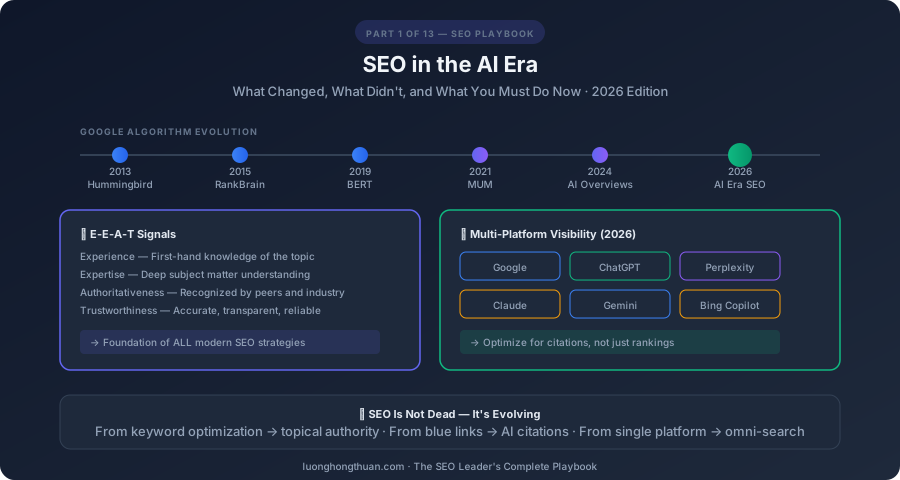
Your SEO strategy must optimize for all of these, not just Google.
The Algorithm Evolution
Understanding how we got here helps predict where we’re going:
2013: Hummingbird — Understanding natural language queries
2015: RankBrain — Machine learning for query understanding
2018: BERT — Bidirectional understanding of context
2021: MUM — Multimodal understanding (text, images, video)
2023: SGE/AI Overviews — AI-generated search results
2024: March Core Update — Massive spam/quality crackdown
2025: AI Overviews expanded globally
2026: Multi-modal AI integration across all Google surfaces
The trend is crystal clear: Google is moving from matching keywords to understanding meaning, and from listing pages to answering questions.
E-E-A-T: The Most Important Concept in 2026 SEO
If you take one thing from this entire series, let it be this: E-E-A-T is not optional — it’s the foundation of everything.
E-E-A-T stands for:
- Experience — Has the author actually done what they’re writing about?
- Expertise — Does the author have deep knowledge or credentials?
- Authoritativeness — Is the author/site recognized as an authority?
- Trustworthiness — Can users trust the content and the site?
Why E-E-A-T Matters More Than Ever
Google’s Search Quality Rater Guidelines — the 170-page document that trains human quality raters — puts E-E-A-T at the center of content evaluation. Here’s why it’s especially critical in 2026:
- AI can generate content at scale — so Google needs signals to distinguish expert content from AI filler
- AI Overviews prefer authoritative sources — your E-E-A-T signals determine whether AI cites you
- YMYL (Your Money or Your Life) topics demand the highest E-E-A-T bar — health, finance, legal, safety
- Users are more skeptical — they need trust signals to engage with your content
How Google Evaluates E-E-A-T
| Signal | What Google Looks For | How to Build It |
|---|---|---|
| Experience | First-hand accounts, case studies, photos | Share real projects, results, personal stories |
| Expertise | Credentials, depth of knowledge, accuracy | Author bios, certifications, detailed content |
| Authoritativeness | Citations, backlinks, industry recognition | Get mentioned by other experts, earn quality links |
| Trustworthiness | Reviews, transparency, security, accuracy | HTTPS, clear policies, honest content, citations |
E-E-A-T in Practice
Here’s the difference between content that passes E-E-A-T evaluation and content that doesn’t:
❌ Low E-E-A-T article: “5 Tips for Better SEO”
- Generic advice anyone could write
- No author attribution
- No sources or data
- No evidence of actual experience
✅ High E-E-A-T article: “How We Increased Organic Traffic 340% in 12 Months — A Technical SEO Case Study”
- Specific results from real experience
- Named author with credentials
- Data-backed with screenshots and analytics
- Links to relevant sources and references
The Death of Keyword Stuffing (And What Replaced It)
If your SEO strategy still starts with “find high-volume keywords and use them 15 times,” you’re operating on 2015 logic. Here’s how keyword strategy has evolved:
Old Approach (Pre-2020)
Target keyword: "best running shoes"
Strategy: Use "best running shoes" in title, H1, first paragraph,
          3 more times in body, meta description, alt text.
Result: Ranked for "best running shoes" (maybe)
2026 Approach
Target topic: Running shoe selection
Strategy: Create comprehensive content covering:
  - How to choose running shoes for different foot types
  - Pronation analysis and shoe recommendations
  - Road vs trail vs track shoe differences
  - Price-performance comparison with real testing
  - Author's 10+ years of running experience
  - Structured data for Product and Review schema
  - FAQ section answering People Also Ask questions
Result: Ranks for 200+ related keywords, gets cited in AI Overviews,
        appears in ChatGPT recommendations
The shift is from keyword targeting to topic authority. Google understands semantics now — it knows “running shoes for flat feet” and “best shoes for overpronation” are related topics. One comprehensive piece of content can rank for hundreds of related queries.
What the Data Says
According to Ahrefs’ 2025 study, the average top-ranking page ranks for 1,890 keywords, not just one. This means:
- Write for topics, not keywords — cover a subject comprehensively
- Use semantic variations naturally — don’t force exact-match keywords
- Answer related questions — include FAQ sections, People Also Ask responses
- Build topical clusters — interlink related content to demonstrate authority
Zero-Click Searches: Winning When Nobody Clicks
58.5% of Google searches in the US end without a click to any website (SparkToro/Datos, 2024). This number is only growing as AI Overviews expand.
Does this mean SEO is dead? Absolutely not. It means the definition of “winning” has changed.
The New Success Metrics
| Old Metric | New Metric | Why |
|---|---|---|
| Click-through rate | Share of voice in SERPs | Visibility matters even without clicks |
| Organic sessions | Brand searches | People see you in AI Overviews, then search your brand |
| Keyword rankings | AI citation rate | Being cited by AI is the new #1 position |
| Pageviews | Engagement depth | Quality of traffic matters more than quantity |
How to Win Zero-Click Searches
- Get cited in AI Overviews — Structure content with direct answers, FAQ schema, and clear headings
- Own featured snippets — These feed AI Overviews and appear above organic results
- Build brand recognition — When users see your brand in multiple AI answers, they search for you directly
- Create content AI can’t replace — Original research, unique data, personal experience, interactive tools
SEO Is Not Dead — It’s Evolving
Every year I hear “SEO is dead” from people who don’t understand what SEO actually is. Let me be clear:
SEO in 2026 is not about tricking search engines. It’s about:
- Creating genuinely useful content that answers real questions
- Building technical infrastructure that serves content fast and accessibly
- Earning authority through expertise, experience, and quality
- Making your content discoverable across all platforms where people search
- Structuring content so both humans and AI can understand it
That is harder than stuffing keywords into a page. That’s why professional SEOs are more valuable than ever.
The SEO Professional’s Expanding Role
| 2015 SEO | 2026 SEO |
|---|---|
| Keyword research | Topic authority strategy |
| On-page optimization | Multi-platform content optimization |
| Link building | Digital PR + brand authority + AI visibility |
| Technical audits | Technical + AI-readiness audits |
| Rank tracking | AI citation tracking + share of voice |
| Monthly reports | Real-time performance dashboards |
Hands-On: Audit Your Site’s E-E-A-T Signals in 30 Minutes
Here’s a practical exercise you can do right now. Score your site on each E-E-A-T factor:
Experience Audit (5 minutes)
- Does your content include first-hand experience (case studies, personal stories)?
- Are there photos, screenshots, or videos from real projects?
- Do you mention specific results with numbers?
- Can readers tell the author has actually done what they’re writing about?
Expertise Audit (5 minutes)
- Does every article have an author with a bio?
- Do author bios include credentials, certifications, or years of experience?
- Is content technically accurate and thorough?
- Are claims supported by data or citations?
Authoritativeness Audit (10 minutes)
- Is your site mentioned by other authoritative sites in your industry?
- Do you have backlinks from respected publications?
- Are there reviews or testimonials from recognized experts?
- Does your brand appear in industry directories or awards?
Trustworthiness Audit (10 minutes)
- Is your site HTTPS with a valid SSL certificate?
- Do you have a clear About page, Contact page, and Privacy Policy?
- Are your content dates accurate and updated?
- Do you cite sources for statistics and claims?
- Is your content free from misleading or sensational claims?
Scoring: Give yourself 1 point for each “yes.”
- 16-20: Strong E-E-A-T foundation — focus on amplifying
- 11-15: Decent — address gaps systematically
- 6-10: Significant gaps — prioritize E-E-A-T improvements before other SEO work
- 0-5: Critical — E-E-A-T should be your #1 priority
Key Takeaways
- SEO in 2026 is multi-platform — optimize for Google, ChatGPT, Perplexity, and beyond
- E-E-A-T is the foundation — without it, no technical trick will save you
- Topics over keywords — comprehensive content outranks keyword-stuffed pages
- AI Overviews are the new #1 — being cited by AI is the highest-value position
- Zero-click isn’t zero-value — brand visibility, authority, and AI citations compound over time
What’s Coming in This Series
This is Part 1 of 13. Here’s the full roadmap:
- Part 1: SEO in the AI Era — What Changed, What Didn’t, and What You Must Do Now (you are here)
- Part 2: The Complete Technical SEO Audit — A 100-Point Checklist
- Part 3: On-Page SEO Mastery — From Title Tags to Topical Authority
- Part 4: Off-Page SEO & Link Building — The Authority Playbook
- Part 5: Core Web Vitals & PageSpeed — Getting a Perfect Score
- Part 6: Content Strategy for SEO — Topic Clusters, Pillar Pages, and Content That Ranks
- Part 7: Advanced Keyword Research — From Search Intent to Semantic Strategy
- Part 8: SEO for AI — How to Get Cited by ChatGPT, Google AI Overviews, and Perplexity
- Part 9: AI-Powered SEO Workflow — Tools, Automation, and Prompt Engineering
- Part 10: Local SEO & International SEO — Ranking Everywhere
- Part 11: SEO Analytics & Reporting — Measuring What Actually Matters
- Part 12: The Complete SEO Best Practices Checklist — Your Team’s Daily Reference
- Part 13: SEO in Action — Step-by-Step for luonghongthuan.com, inkviet.com & cublearn.app
In Part 2, I’ll give you a 100-point technical SEO audit checklist — the exact process I use when auditing a new site. From crawlability and indexing to structured data and log file analysis, you’ll have a complete framework for finding and fixing every technical SEO issue.
This is Part 1 of “The SEO Leader’s Complete Playbook” — a 13-part series covering everything from technical foundations to AI-era strategies. Written for SEO teams who want practical, hands-on guidance based on 10+ years of real-world experience.