
PRODUCT CASE STUDY
Earshot
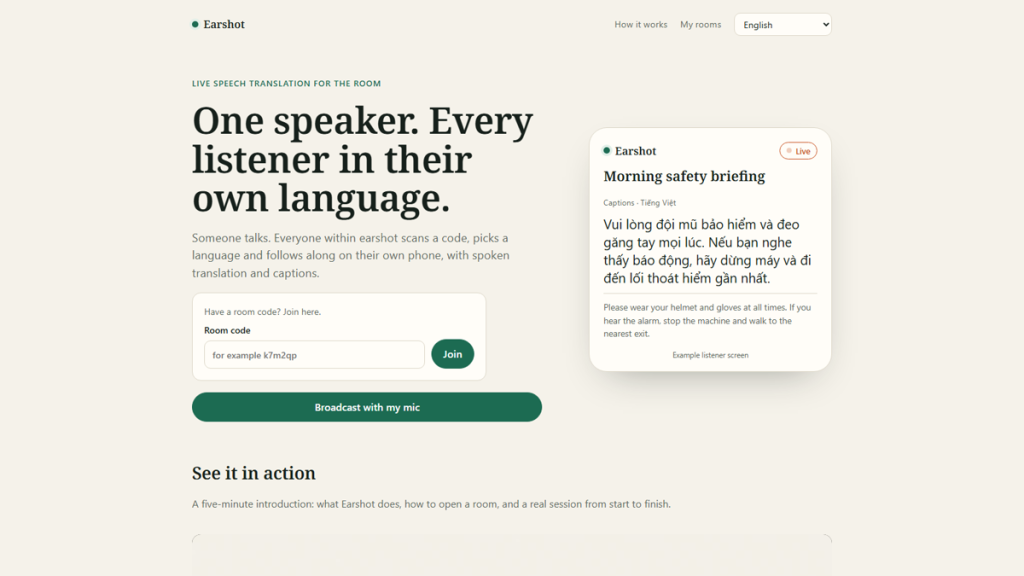
Realtime one-to-many speech translation: one person speaks, everyone in the room listens in their own language, by voice or captions.
- Role
- Product lead and engineering lead — live translation, rooms and operations
- For
- Event organisers, churches, schools and teams whose audience speaks many languages
On this page
The user problem
When a talk, a service or a site tour has listeners who speak different languages, organisers either hire interpreters for a few languages or leave part of the room behind. Listeners do not want to install an app or create an account just to follow along.
Product decisions
The speaker opens a room and talks. Listeners scan a QR code or open a link, pick their language and hear the translation, or read live captions. Rooms also support two-way conversations and multilingual meetings. Organisers can translate recordings after an event, prepare readings in every language ahead of time, keep a glossary for names and terms, and receive a short summary when the session ends. The listener interface is available in 31 languages.
Engineering trade-offs
Audio travels over a self-hosted WebRTC server, and a translation bridge runs only for the languages someone is actually listening to, then stops when they leave. That keeps cost tied to real listeners. Recordings, readings and summaries are background jobs, so the live path stays fast. The product runs on one small server with nightly backups, an off-site copy and uptime monitoring, which suits a trial but would need more capacity for large events.
What exists today
The public site, listener page, organiser pages and live translation were checked on 8 and 9 November 2026 during a trial week. Feedback, a privacy page, automated backups and monitoring are in place. Translation quality has been reviewed informally; latency and accuracy have not been measured independently across languages, and there are no published usage numbers yet.
Evidence & next steps
Implementation evidence is separate from measured user or business outcomes. Next: validate the complete user journey and its results.