
JOURNAL
Anthropic’s S-1: The Real Numbers Behind the $80.7 Billion Headline
Anthropic filed to go public with an $80.7B headline loss, $16.3B in revenue and $450B in locked-in cloud spend. What the S-1 actually says, and what matters if you're building on top of Claude.

On this page
$16.3 billion. That’s Anthropic’s revenue for the first six months of 2026, about fifteen times the $1.1 billion it made over the same stretch a year earlier. Turn a few pages further into the S-1 Anthropic filed with the SEC this week and you hit a very different number: an $80.7 billion net loss for those same six months.
Read past the headline and most of that loss evaporates. Roughly $72 billion of the $80.7 billion is a non-cash accounting charge, the rising fair value of convertible notes and other financing instruments Anthropic issued in earlier funding rounds. No cash left the company because of that line. Strip it out and the real operating loss for the half was about $8.7 billion. Still a loss. Not the number every headline led with.
The $8.7 billion gets easier to read once you see the infrastructure line next to it: compute spending for the half came in near $9 billion, up from $2.3 billion a year earlier. Training and serving frontier models costs money roughly in proportion to how many people are using them, and usage grew fifteenfold alongside it. Third-quarter revenue climbed a further 45% sequentially to $16.8 billion, and Anthropic told investors it reached adjusted profitability that quarter. The trend line, not the headline loss, is the number that should move a decision.
The $450 billion bet, broken down
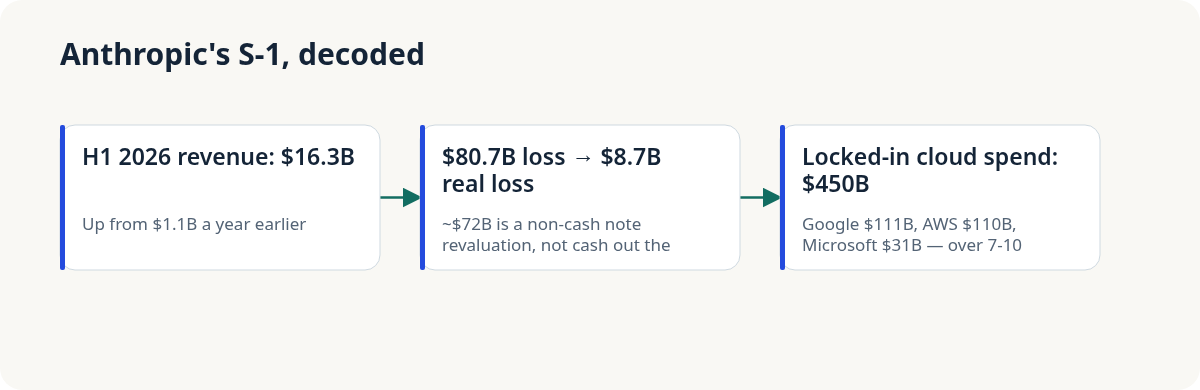
The number that should actually give a technical reader pause sits further into the filing: roughly $450 billion in mostly non-cancelable cloud commitments over the next seven to ten years, split three ways, Google Cloud at $111 billion, Amazon Web Services at $110 billion, Microsoft at $31 billion. Add option-like commitments for chips, up to $86 billion to Nvidia and up to $160 billion tied to Broadcom-fabricated Google silicon, and total potential obligations run as high as $750 billion, still under negotiation. One outlet sized that figure against Switzerland’s annual GDP. Fair comparison. Not the number I’d worry about first.
Context on the valuation matters too. Anthropic’s last private funding rounds put it near $2 trillion; the figures circulating around this filing point closer to $1.5 trillion. That’s not a company in trouble, it’s a market repricing growth-stage AI valuations down from the peak of the hype cycle while the underlying revenue is still growing fifteenfold year over year. Those two facts aren’t in tension. A markdown off a private-market peak and a real, compounding revenue curve can both be true at the same time, and reading the S-1 as only one or the other misses what’s actually in it.
Why three clouds, not one
Splitting $450 billion three ways across Google, AWS and Microsoft is not incidental. It’s Anthropic refusing to let a single cloud provider hold veto power over whether Claude stays online, priced reasonably, or available at the capacity its customers expect. If you build a product with hard dependencies on Claude’s API, that multi-cloud posture is the single most reassuring fact in the whole filing: Anthropic already did the vendor-risk thinking that a single-cloud startup usually skips. It also means Anthropic is betting revenue keeps compounding near its current rate, because $450 billion in mostly non-cancelable spend doesn’t shrink if growth slows.
The risk that actually belongs to you
Buried further down is a detail worth more attention than either giant number: about one-fifth of Anthropic’s revenue comes from just two customers. That’s a standard S-1 risk disclosure, not a scare line, and it cuts in a specific direction. If you’re one of those two customers, you have real leverage over pricing, support and roadmap. If you’re not, you’re one of thousands of API accounts competing for attention and capacity during the moments when a frontier lab’s infrastructure gets tight. Anthropic also flagged, in its own risk factors, the possibility of models exhibiting self-preserving behavior or responses resembling blackmail, language a company doesn’t put in a legal filing lightly.
What this means if you build on Claude
None of this is a reason to panic about Claude disappearing. A company locking in $450 billion across three clouds for the next decade isn’t planning to go anywhere. The practical takeaway is about leverage, not survival: ask your own vendor-risk questions the way Anthropic’s filing invites you to. What’s your actual committed capacity versus list pricing. What tier of customer are you. What happens to your product the week a frontier provider’s infrastructure is tight and priority has to go somewhere. Anthropic wrote the answer to that question about itself into a legal filing. Most of us never get asked, so we never write it down.
The $80.7 billion number will dominate headlines this week. The one-fifth-from-two-customers line is the one actually worth rereading.
Sources
Anthropic SEC S-1 filing, October 2026 (sec.gov/Archives/edgar/data/0002130357); financial figures as reported by Yahoo Finance, October 2026.
Related reading
· 6 min read
ai-agents
Anthropic Replaced Git With Scion. The Interesting Part Is What Happens When a Bad Merge Lands First and Tests Run After.
Anthropic built an in-house version control system because Git assumes clients work offline — and agents don't. The throughput numbers are real. The failure-mode story is missing.
Read more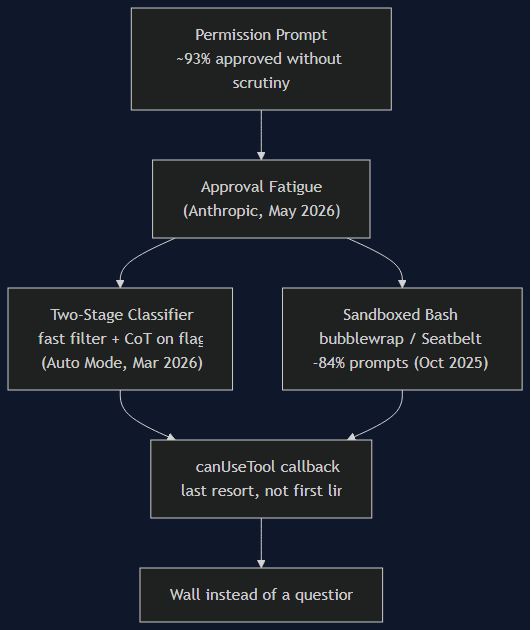
· 5 min read
agents
Anthropic Says You Approve 93% of Permission Prompts Blind. Here's What Actually Stops the Bad 7%.
Anthropic's own telemetry says users approve roughly 93% of Claude Code's permission prompts without real scrutiny. Two 2026 engineering posts, a sandboxing feature, and an SDK callback show what they built instead of asking harder — and it's not a smarter warning dialog.
Read more
· 5 min read
agentic coding
Claude's Mid-Conversation Tool Changes: Swapping Tools Without Blowing Up Your Cache
Anthropic shipped a beta that lets you add or remove tools mid-conversation without invalidating the prompt cache. Why that matters for long-running agents, and what I changed in my own agent's tool-loading logic after reading the spec.
Read more
Discussion
Comments are reviewed before publication. Your email is kept private.