
JOURNAL
flowscope’s AI Process Consultant: A DIY Pilot You Can Run Without It
A YC-backed startup pitches AI agents that map your workflows and automate the single highest-value step. Here's what the public evidence actually supports, and a free two-week pilot template any team can run first.

On this page
60-second summary
flowscope (ycombinator.com/companies/flowscope) is a Y Combinator Spring 2026 company selling a three-step service: Map, Optimize, Automate. It observes how a team’s processes actually run, redesigns the process around what AI agents can do, then deploys agents to automate the single highest-value step on top of existing systems, not a new system of record. It was founded in 2025 by Samuel Mirpuri (CEO, ex-McKinsey, Harvard MBA) and Javier Leguina (CTO, two-time founder, previously at ModelML and Encord), a two-person team based in San Francisco. Its own case studies name three customers, Rush Resources, Momento, and Trace Services, citing figures like 214 invoices matched, 1,380 bank lines reconciled, 41 deals updated from sales calls, and one customer credited with $500K in annual savings. These are flowscope’s own published figures; no independent audit or customer confirmation was found. The one process detail shown publicly, an “Exception review” step in its invoice-processing example, suggests a human checkpoint remains, though the approval mechanism isn’t documented. You do not need flowscope to test the underlying idea. The same shadow, rank, automate, review pattern is something any team can run as a time-boxed pilot before paying a vendor to do it for them.
The problem it’s aimed at
Mid-market companies and private-equity portfolio companies tend to carry operational processes, invoice matching, bank reconciliation, updating deal records from sales calls, that run on manual, repetitive work spread across people and systems that were never designed as a coherent whole. The usual fix is “buy new software,” and the usual failure mode is that the actual bottleneck, nobody reconciling bank lines by hand, doesn’t go away, it just moves to whoever has to operate the new system. flowscope’s pitch is explicit about avoiding that trap: it says it deploys agents on top of the tools you already use (inbox, ledger, CRM) rather than asking you to adopt a new system of record. Whether that promise holds up in practice is unverified from the public site, but it is a reasonable response to a real and common failure pattern.
A concrete scenario
A 40-person operations team at a private-equity-backed industrial services company spends several hours a week manually matching invoices against purchase orders and reconciling bank statement lines against the ledger. Nobody has measured exactly how many hours; it is simply the work two people do between other tasks. This is close to the customer profile flowscope names in its own case studies (Rush Resources for hiring and onboarding automation, Momento for accounts payable and receivable automation), and it is also exactly the kind of shop that can run the pilot below without paying flowscope, or anyone, to find out whether there’s a real problem worth automating.
The two-week demand test
Before paying any AI-process vendor, time-box a DIY pilot with six steps. First, shadow the real workflow for two weeks and log every manual step, who does it, and how long it actually takes, not how it’s documented on paper. Second, rank the logged steps by total hours lost per week, not by which one looks most interesting to automate. Third, pick the single highest-hours step and write a clear pass/fail rule for what “correct” output looks like before building anything. Fourth, have an agent, your own script, a low-code tool, or a vendor pilot, draft the output for that one step only, on top of the systems you already use. Fifth, route low-confidence or out-of-policy cases to a human before anything is sent, posted, or booked, mirroring the “Exception review” checkpoint flowscope itself shows in its invoice example. Sixth, measure hours saved and error rate against the pre-pilot manual baseline, same step, same time period. This test has not been run for this article; it is a proposed template, not a reported result.
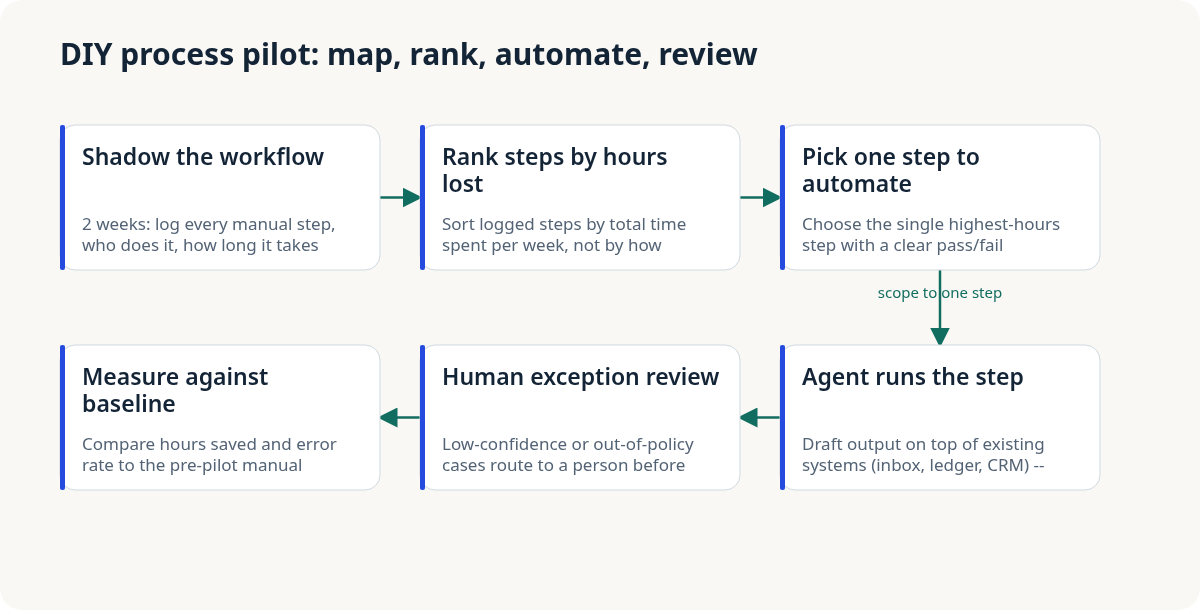
Getting it running
- flowscope’s own methodology, per its site, is Map (capture current workflows, who performs each task, bottlenecks, repetitive work), then Optimize (redesign the process around what AI agents can actually do, using the company’s organizational knowledge), then Automate (deploy agents into production on existing systems, not a new one).
- Running the DIY version needs no new tooling commitment for the shadowing phase: a shared spreadsheet or whatever time-tracking the team already has works. The automation phase then uses whatever fits the one chosen step, a script, Zapier or Make, or an AI agent framework.
- If evaluating flowscope or a competitor, run the two-week shadow phase first and bring that log into the vendor conversation, so the team is testing a vendor’s fit against its own measured numbers rather than taking a case-study page’s word for what’s worth automating.
How it’s described to work
flowscope’s compliance page states that customer data is processed through third-party LLM subprocessors, naming OpenAI specifically, under a contractual Zero Data Retention agreement, meaning OpenAI does not retain or train on flowscope customer data under that contract, per flowscope’s own description, not an independently audited claim. It states only company-selected “work apps” are connected, personal accounts are excluded, personal data is redacted on-device and again before storage, and all customer data is processed and stored in the United States. A SOC 2 Type I report is dated August 2026, and GDPR and HIPAA badges are displayed on the same page. A SOC 2 Type I is a point-in-time review of whether controls are designed correctly; it is not the more rigorous Type II audit, which tests whether those controls actually operated correctly over a period of months. That distinction is worth asking about directly if compliance is a condition of any pilot.
What this costs and where it breaks
The evidence here is mixed, and worth being explicit about. The specific customer figures, 214 invoices matched, 1,380 bank lines reconciled, 41 deals updated from calls, and one customer credited with $500K in annual savings, are flowscope’s own case-study numbers. No third-party audit or named customer confirmation of these figures was found in the public record. The only documented human-checkpoint detail is the single “Exception review” step shown in the invoice example; what counts as an exception, who reviews it, and the service-level expectation for that review are not public. On the compliance side, SOC 2 Type I (not Type II) means controls were reviewed as designed at one point in time, not tested operating over a period, a meaningfully weaker bar than what many buyers assume “SOC 2 compliant” means. And flowscope itself is a two-person company founded in 2025; any multi-year automation commitment to a vendor this size carries ordinary startup-continuity risk that is worth weighing against the convenience of not building the pilot in-house.
Sources
- flowscope Y Combinator company profile, retrieved 2026-10-15
- flowscope.com, retrieved 2026-10-15
- trust.flowscope.com compliance page, retrieved 2026-10-15
Where to go next
If you want help running the two-week shadow-and-rank pilot above against your own operations data before talking to any AI-process vendor, Thuận Lương’s consulting practice helps teams scope exactly that kind of pilot. Reach out through luonghongthuan.com/en/contact.
Related reading

· 9 min read
AI Ideas
Magnitude: A YC Startup Betting Generic AI Kernels Leave Speed on the Table
A Y Combinator startup's open-source inference engine claims to beat Ollama by tuning kernels to your exact chip. Its own benchmark says 1.3x-2.2x on average, not the 2x+ headline. Here's what the repo, benchmark and docs actually show.
Read more· 7 min read
AI Ideas
XERJ's Open-Source AI Search Engine: What the Numbers Actually Say
A fast-growing open-source search engine claims 40x fewer tokens than grep for AI coding agents. Its own benchmark says 2.7x. Here's what the repo, security docs, and case study actually show.
Read more
· 6 min read
AI Ideas
IncidentFox's Open-Source AI SRE Agent: What You're Actually Getting
A YC-backed AI agent promises to investigate production incidents for you. Here's what the public repo, license files, and GitHub metadata actually show once you look past the landing page.
Read more
Discussion
Comments are reviewed before publication. Your email is kept private.