
JOURNAL
Open WebUI and Ollama: test an internal AI workspace before buying a GPU
A scoped internal AI pilot: choose tasks, map data flow, measure quality and latency, then decide whether server investment makes sense.
On this page
The idea in one minute
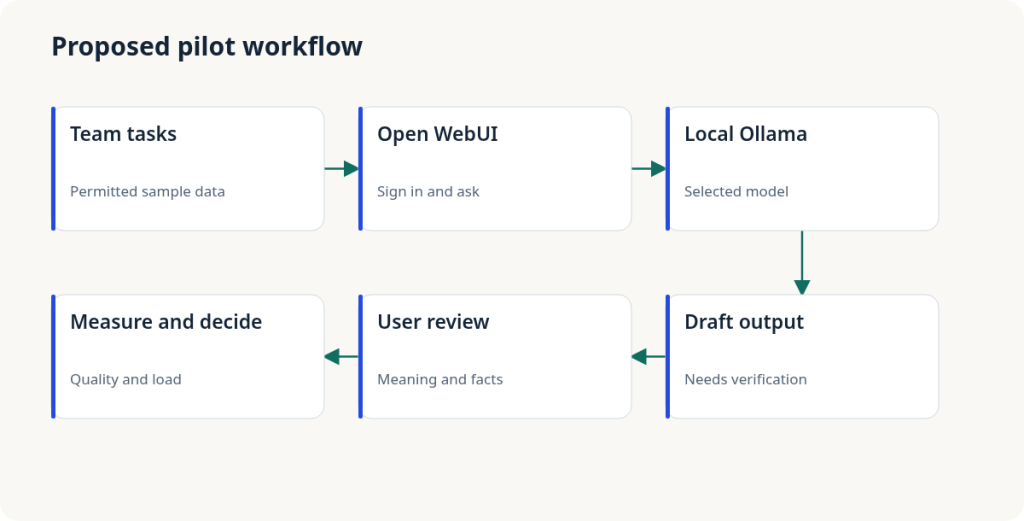
A small team wants AI to edit text and summarize internal notes but is unsure whether to buy a GPU server. The proposed experiment creates an authenticated workspace, selects a suitable local model and measures permitted tasks. Open WebUI is the interface; Ollama is one option for model execution. Tool names alone do not establish quality, privacy or economic value. This article is a pilot plan, not a measured new installation.
What the two tools do
The Open WebUI quickstart documents deployment and an Ollama connection. Think of the interface as the place to ask and the model server as the place generating the answer. An external API can send data outside even when the interface is locally hosted. Map the browser, backend, model, plugins and logs before making privacy claims.
Choose tasks before models
Pick three small tasks: rewrite a product description, summarize synthetic meeting notes and turn notes into a checklist. Define good outcomes for each. Initially leave web access, customer-data uploads and write-capable tools disabled. Explain that fluent text can still omit facts. Policy lookup needs a separate source and review design; a chat window does not automatically know company material.
A checkable task example
Synthetic notes say Mai prepares the demo before Tuesday, Nam confirms the data and the team meets at 14:00. A good checklist preserves the people, actions and times while flagging ambiguity. Inventing an owner or changing a time is a failure. Begin with this synthetic material to avoid using sensitive notes in the first experiment. Staff review outputs before treating them as customer commitments.
Try existing hardware first
Run roughly 15 prepared tasks, first with one user and then with expected concurrency. Record response-start time, completion time, memory use and corrections. This sample explores initial limits. Model size alone does not guarantee speed; context length, configuration and simultaneous load need measurement. If current hardware is slow but output useful, test a larger configuration or a short-lived evaluation environment.
Implementation steps
Follow the official quickstart, choose a checked version and persist application data. Create the administrator first, then limit access to pilot participants. Connect to a private model endpoint and enable only needed features. For local-only needs, the Ollama FAQ documents OLLAMA_NO_CLOUD=1 followed by a restart. Inspect logs and actual network traffic; this setting does not automatically disable every UI API connection or plugin.
Technical view: network and data boundaries
Keep the model port off the public Internet. Protect the interface with appropriate authentication and HTTPS, and restrict who adds connections or plugins. Separate trial chat history from shared documents and define retention and log access. Back up persistent data and test restoration in an isolated environment. Record UI version, model, configuration and task set for fair comparisons after upgrades. Verify these controls in the actual deployment.
Licensing and real operating cost
Read the current Open WebUI license before rebranding or packaging a service; it includes branding conditions. The selected model has its own license. Budget for electricity, storage, backups, monitoring, updates and administrator effort as well as GPU hardware. Low usage does not establish that a private server is cheaper. Compare total cost and acceptable quality using the team’s measurements.
Expand after evidence
Continue when users complete tasks better, correction time is acceptable and concurrency is manageable. Stop if important facts are repeatedly omitted or administration outweighs the benefit. A useful extension is a role-based task library for marketing, operations and support, each with inputs, a good-output example and review criteria. Sharing repeatable workflows gives users more guidance than expecting everyone to invent effective prompts.
Next step
For a similar process, start with an AI opportunity assessment to define scope and evaluation criteria. Once inputs, outputs and review are clear, explore AI MVP delivery for a prototype you can evaluate.
Sources and research boundary
Primary sources checked on 10 October 2026. Scenarios, sample sizes, architecture and business ideas are editorial proposals. No benchmark or customer outcome is claimed.
Related reading
· 4 min read
AI Ideas
Read supplier quotation PDFs with Docling: prepare a comparison for review
A proposed workflow to turn quotation PDFs into a reviewable comparison with units, tax assumptions, delivery terms and source references.
Read more
· 4 min read
AI Ideas
An AI receptionist for appointment businesses: start with missed calls
A proposed startup pilot for service businesses: capture enquiries, prepare appointment requests and hand off to staff before building a larger product.
Read more
· 5 min read
AI Ideas
A document assistant with Dify: start with a reviewable pilot
A practical proposed pilot for internal document lookup: sources, human review, evaluation, self-hosting and license checks.
Read more
Discussion
Comments are reviewed before publication. Your email is kept private.