
JOURNAL
A document assistant with Dify: start with a reviewable pilot
A practical proposed pilot for internal document lookup: sources, human review, evaluation, self-hosting and license checks.
On this page
Understand the idea in one minute
A document assistant helps a team find an answer in material it already owns: operating instructions, product notes or frequently asked questions. The useful promise is narrow: find the right passage and prepare an answer a person can check. For a first experiment, avoid a bot that speaks to customers without review. Start with an internal tool for one team and one document collection. This article proposes a pilot; it does not report a completed installation or measured customer result.
Who is it for?
Consider a small distributor whose staff repeatedly ask which products can be returned, what evidence is required and who approves an exception. Answers are scattered across PDFs and old messages. The initial problem is inconsistent retrieval, not a lack of fluent writing. A useful pilot gives staff a source and a version date. If the real problem is that policies contradict each other, reconcile those policies before building AI around them.
Where Dify fits
Dify brings visual AI workflows and knowledge-retrieval capabilities into one platform. That makes it a candidate for prototyping the workflow described here, rather than a guarantee that the resulting application will be reliable. See the official repository. The proposed steps below are editorial implementation guidance, not instructions tested on a new Dify deployment during this article.
A concrete example
A staff member asks: “The customer opened the box yesterday. What should I check before accepting a return?” The desired answer identifies the relevant policy, explains the required information and names the escalation path. It should not invent an approval. If the retrieved policy concerns a different product or an old date, the right response is uncertainty and a request for human help. Keep the final return decision with the authorized staff member.
Start with a small experiment
Select one process, such as return-policy lookup. Prepare 15–20 real questions with expected source passages, including ambiguous questions and questions the collection cannot answer. These counts are suggested experiment sizes, not benchmark requirements. First have two staff members answer using the current process; then compare a reviewed AI draft. Record correctness, source relevance, time spent checking and unsupported claims. Do not put confidential customer details into a public model merely to make the example realistic.
Prepare the knowledge before the bot
Give each document an owner, review date and access classification. Remove obsolete copies and separate material that not every user may see. Dify’s knowledge-base guide describes importing material, configuring chunks and retrieval, and processing it. For the pilot, inspect retrieved passages before asking the model to compose answers. A beautifully written answer cannot repair a missing or irrelevant source.
Implementation steps
Choose a checked Dify release and follow its official deployment guide; confirm current prerequisites there. Set up an isolated pilot, select a model provider, import the approved collection and test retrieval. Build a flow that retrieves evidence before composing an answer. Require an answer to cite relevant passages or say it cannot answer. Add the review screen and escalation route before inviting staff. Finally run the question set again after any document, prompt or retrieval change.
Technical design and self-hosting
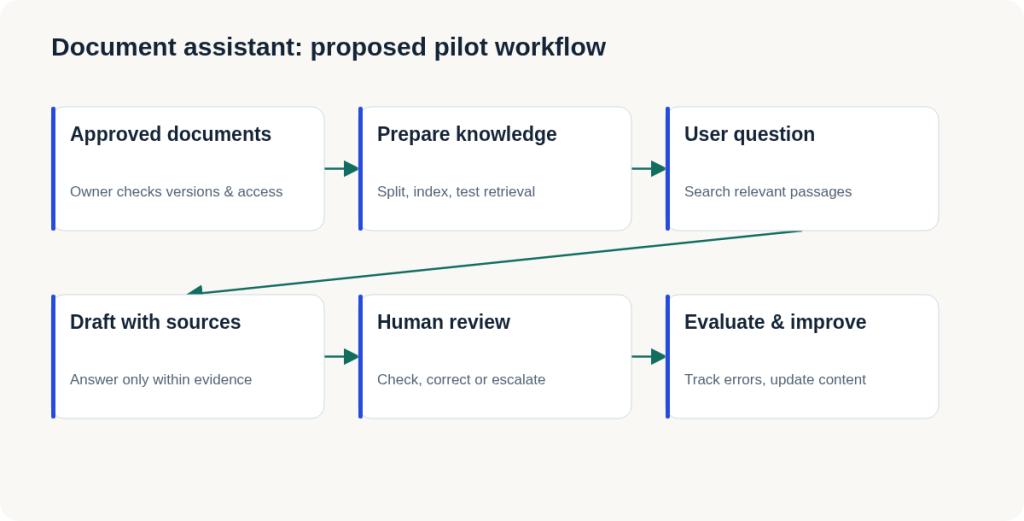
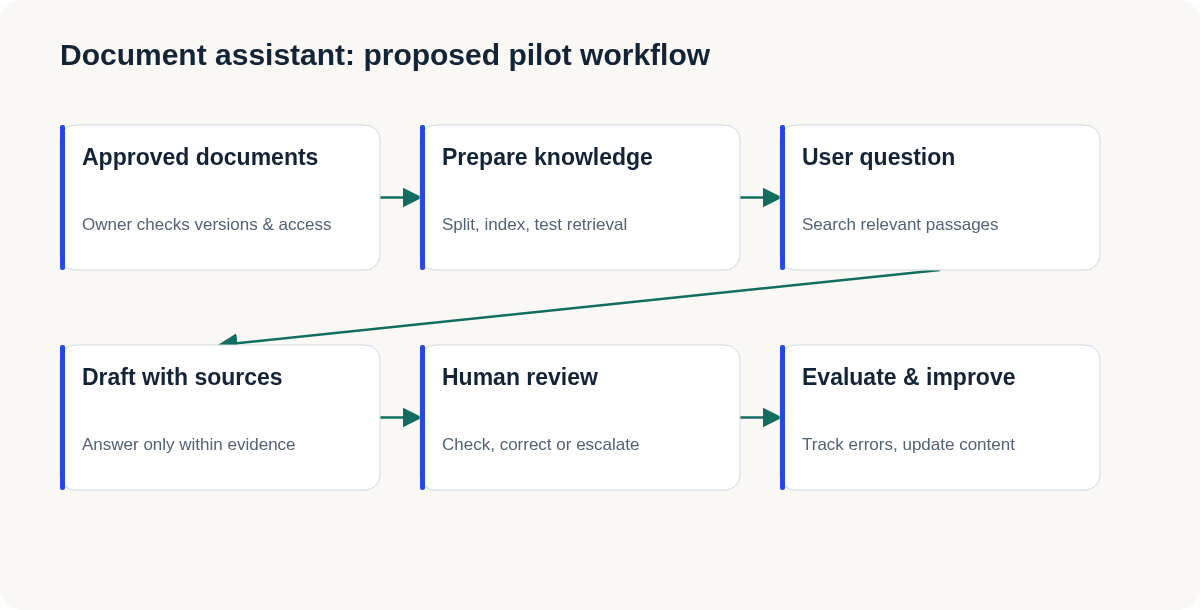
Keep application access, document permissions and model-provider credentials separate. Self-hosting the orchestration application does not automatically keep inference local: map every external model, embedding and integration call. Choose permissions at retrieval time so users cannot query documents they cannot access. Store secrets in deployment configuration, protect logs and set a backup/restore procedure. The diagram describes the logical pilot flow; it does not certify that every control is implemented by a default installation. For production, verify each control with an actual test.
License and operating cost
Read the current Dify license before turning this into a commercial service. It modifies Apache 2.0 with additional conditions covering multi-tenant use and frontend branding. Check those conditions for your intended deployment rather than assuming all business models are unrestricted. Estimate infrastructure, model and embedding usage, storage, review time and maintenance separately. Keep your calculation as a stated assumption; do not quote a universal monthly cost.
What counts as a useful result?
Agree evaluation criteria before trying the tool. For this proposed pilot, the team might require every supported answer to point to a valid passage and every known out-of-scope question to escalate. Choose tolerances for minor wording errors separately from errors that change a policy decision. Expand the question set when staff discover new failure cases. Report denominators alongside percentages: “18 correct out of 20 reviewed questions” is more informative than a vague claim of high accuracy. No such result is claimed here.
When to stop or change direction
Pause the pilot if document permissions are unclear, reviewers cannot distinguish evidence from inference, or checking drafts takes longer than the existing process. A searchable policy index may solve the need without a generative answer. If users value retrieval but distrust prose, keep the search and show passages directly. Treat that as a useful product discovery. The objective is a dependable workflow, not using the largest possible collection or making the bot autonomous.
Next step
Choose one bounded workflow, prepare its documents and question set, and test a reviewable prototype before connecting customer-facing actions. If you want help deciding where AI fits, start with an AI opportunity assessment. For a scoped application, explore AI MVP delivery.
Sources and research boundary
Primary sources checked 10 October 2026. The scenario, experiment and architecture are editorial proposals; no Dify deployment benchmark is claimed.
Related reading
· 4 min read
AI Ideas
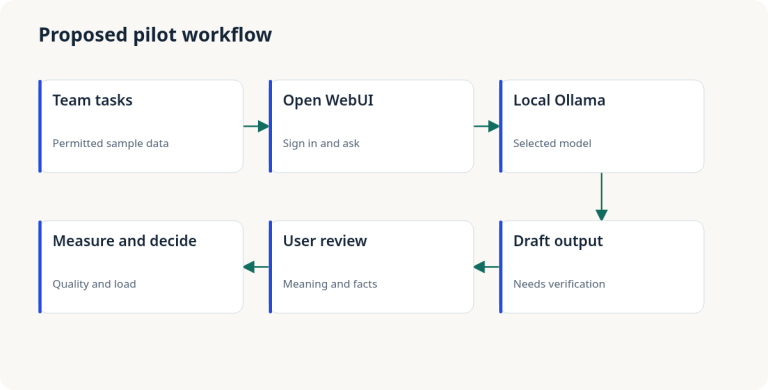
Open WebUI and Ollama: test an internal AI workspace before buying a GPU
A scoped internal AI pilot: choose tasks, map data flow, measure quality and latency, then decide whether server investment makes sense.
Read more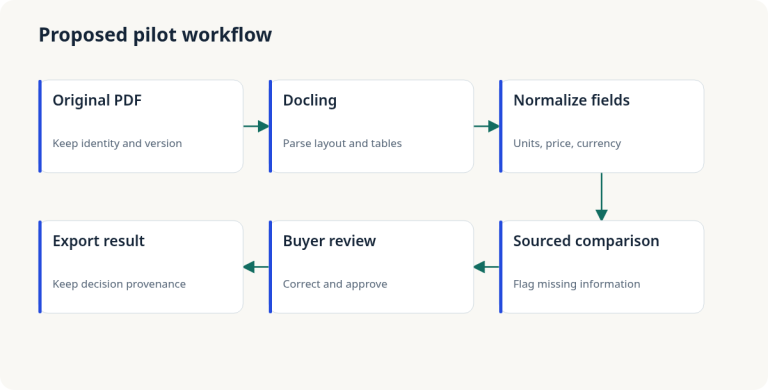
· 4 min read
AI Ideas
Read supplier quotation PDFs with Docling: prepare a comparison for review
A proposed workflow to turn quotation PDFs into a reviewable comparison with units, tax assumptions, delivery terms and source references.
Read more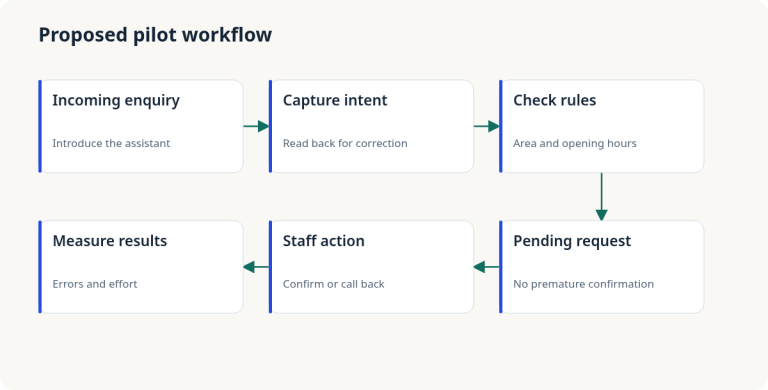
· 4 min read
AI Ideas
An AI receptionist for appointment businesses: start with missed calls
A proposed startup pilot for service businesses: capture enquiries, prepare appointment requests and hand off to staff before building a larger product.
Read more
Discussion
Comments are reviewed before publication. Your email is kept private.