
JOURNAL
You Can’t Ship Agents on Vibes — Evals for Agentic Systems
A one-line prompt tweak can silently break an agent, and you won't notice until a user does. My fix is an eval harness: a golden set of inputs and checks, run against every agent and workflow on every change. Here's the anatomy — deterministic checks, LLM-as-judge, run-on-change regression, and grading multi-agent workflows.
On this page
Here’s the failure mode nobody warned me about. I tweak an agent’s system prompt to fix one thing, it looks fine in a quick test, I ship it — and three other behaviors I’d carefully tuned quietly regress. Nobody notices until a user hits one. Agents are non-deterministic and their behavior is smeared across a prompt, a model, a temperature, and a tool list. You cannot eyeball that.
The fix is old news in software and overdue in agents: a test suite. In this world I call it an eval harness — a golden set of inputs and expected properties, run against every agent (and every workflow) on every change.
An eval is an input plus checks, run against a target
The unit is small. An eval names a target (an agent or a workflow), an input to send it, and a list of checks the output must satisfy. Running it is mechanical:
flowchart LR
  E["Eval: input + checks"] --> R["Run the target<br/>(agent or workflow)"]
  R --> O["Output + cost + latency"]
  O --> C{"Apply checks"}
  C -->|all pass| P["✅ pass"]
  C -->|any fail| F["❌ fail + which check"]
  P --> L["Log the run"]
  F --> L
A run captures more than the text: the output, the token cost, the latency, and any error. That lets my checks assert on behavior and budget — “answers correctly” and “under $0.02” and “under 3s.”
Two kinds of checks: deterministic and judged
Most properties are cheap to check with code. A few need judgment, so I borrow another model.
| Check | Asserts | Cost |
|---|---|---|
contains / not_contains |
a string is (n)present | free |
regex |
pattern matches | free |
equals / min_len |
exact output / minimum length | free |
json_valid |
the output parses as JSON | free |
max_cost / max_ms |
budget and latency ceilings | free |
no_error |
the run didn’t throw | free |
judge |
an LLM grades against a rubric | one model call |
I reach for deterministic checks first — free, fast, unambiguous. json_valid alone catches a huge class of
“the model wrapped it in prose” regressions. I use the judge only for genuinely fuzzy properties: “is this
a polite refusal?”, “does it cite a source?”
The judge: a strict, independent grader
LLM-as-judge is a second model, independent of the agent under test, handed a rubric and the answer and asked for a single verdict. Keep it strict and structured:
You are a strict evaluator. Given a RUBRIC and an ANSWER, decide whether the
answer satisfies the rubric. Reply with a single word PASS or FAIL, then a
colon and one short sentence.
Temperature 0, a short token budget, PASS/FAIL first so parsing is trivial. The independence matters —
never let an agent grade its own homework with its own prompt.
Run-on-change: the regression net
An eval suite you have to remember to run is an eval suite you won’t run. The leverage is automatic regression: when I edit an agent’s behavior-affecting fields — its prompt, model, tools, temperature — its evals fire in the background and flag any that flipped to failing.
flowchart LR
  Edit["Edit agent<br/>(prompt / model / tools)"] --> Q{"has evals?"}
  Q -->|yes| Run["run its golden set"]
  Q -->|no| Skip["skip"]
  Run --> Diff["report pass/fail<br/>+ Telegram on regressions"]
Now the golden set is a safety net stretched under every change, not a chore. A red result the moment I save is worth ten green results I ran a week ago.
Grade workflows, not just agents
Single-agent evals are table stakes. The interesting failures live in multi-agent workflows — an orchestrator delegating to specialists, or a node graph fanning out and back in. Those need the same treatment: run the whole workflow on a golden input, then check the final synthesized output.
The trick is to make the target polymorphic. An eval’s target_kind is agent or workflow; the
harness runs the right executor and applies the identical checks to whatever comes out. If your eval runner
only knows how to run single agents, your most complex — and most fragile — systems are the ones going
ungraded. (That was a real gap in mine until recently; workflows now grade the same way agents do.)
The golden set is a living spec
The quiet payoff: my evals become the executable definition of what each agent is for. “Refuses off-topic requests.” “Always returns valid JSON.” “Cites at least one source.” “Costs under two cents.” Every check is a promise, and the suite is the promise I can run. New behavior starts as a new eval; fixing a bug starts by writing the eval that would have caught it.
You don’t need a platform to start — you need three columns (input, check, target) and the discipline to run them on every change. Agents earn trust the same way code does: not by looking right, but by passing.
Related reading
· 4 min read
devops
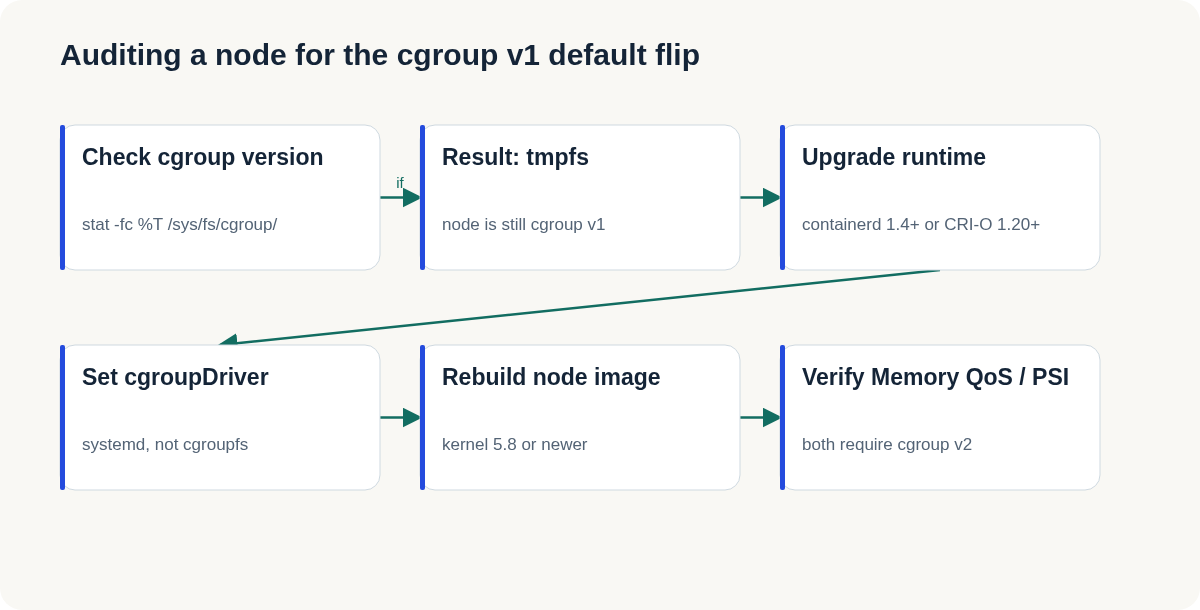
Kubernetes Just Flipped a Default That Will Refuse to Boot Your Old Nodes
Kubelet's failCgroupV1 field defaulted to true in 1.35. A cgroup v1-only node won't start anymore unless you explicitly override it. Here's how to check today.
Read more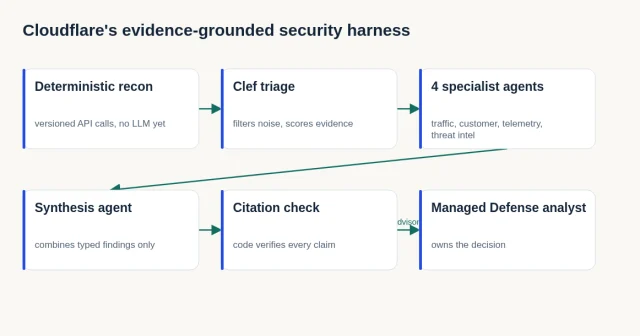
· 4 min read
Priority articleai-agents
Cloudflare Built a Security Agent That Checks Its Own Citations Before an Analyst Sees Them
Cloudflare's new Managed Defense harness admits its first prototype hallucinated, then redesigned around code-verified citations instead of trusting one big agent.
Read more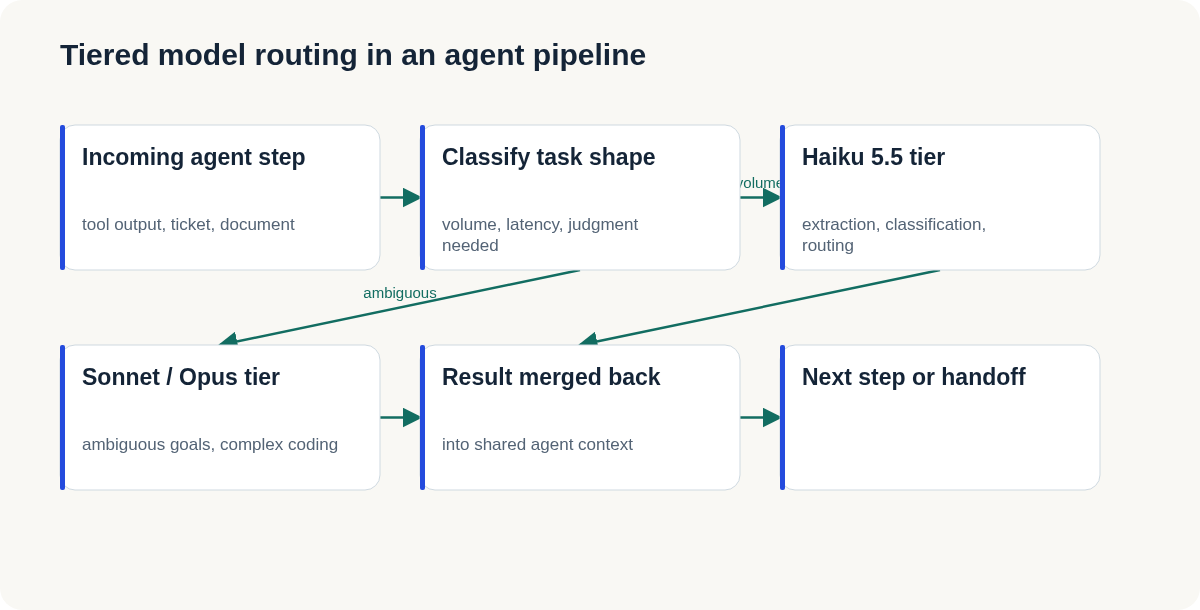
· 4 min read
ai-agents
Claude Haiku 5.5 and the Real Math Behind Cheap Model Routing
Haiku 5.5 is 75% cheaper and far sharper at agent tasks, but a token-efficiency tax means the real savings aren't the headline number.
Read more
Discussion
Comments are reviewed before publication. Your email is kept private.